
Provenance
Purchased in Paris by (James Mackinnon, London);[1] purchased 1999 by Frank Anderson Trapp [1922-2005], Pittsburgh; gift 2004 to NGA.
[1] According to handwritten note by Mr. Trapp, in NGA curatorial files.
Accession Number
2004.166.15
Medium
oil on paper
Dimensions
overall: 22.9 x 29.5 cm (9 x 11 5/8 in.) | framed: 37.8 x 44.5 x 5.1 cm (14 7/8 x 17 1/2 x 2 in.)
Classification
Painting
Credit Line
Gift of Frank Anderson Trapp
Tags
Painting Neoclassical & Romantic (1751–1850) Oil Painting French
Background & Context
Background Story
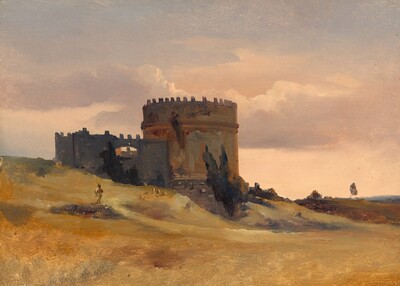
Leon-Francois-Antoine Fleury (1804-1858) was a French painter known for the precisely observed Italian landscape paintings that he produced during his time in Rome as a pensionnaire at the French Academy. On the Bay of Naples from c. 1830 depicts the Bay of Naples in the precisely observed, atmospheric manner that distinguishes Fleury's best Italian landscapes from the more idealized landscape painting of his contemporaries. The c. 1830 date places this in Fleury's Italian period, when he was producing the precisely observed Italian landscapes that are his most accomplished works.
Cultural Impact
On the Bay of Naples is important in the history of French landscape painting because it demonstrates the precisely observed Italian landscape tradition that French pensionnaires developed during their time at the French Academy in Rome. The tradition of French artists painting precisely observed Italian landscapes during their time in Rome was one of the most productive in 19th-century French landscape painting, and the c. 1830 painting shows this tradition at its most atmospheric and precise.
Why It Matters
On the Bay of Naples is Fleury's precisely observed Italian landscape: the Bay of Naples rendered in the atmospheric manner of a French pensionnaire at the French Academy in Rome. The c. 1830 painting shows the productive tradition of French artists painting precisely observed Italian landscapes during their time in Rome.
![Saint Bernard and Saint Catherine of Alexandria with the Virgin of the Annunciation [right panel]](https://api.nga.gov/iiif/e6890364-4d99-4684-a62b-5060ee3c3446/full/400,/0/default.jpg)