
Provenance
(Michael Harvard, London); purchased early 1970s by Frank Anderson Trapp [1922-2005], Amherst and Pittsburgh; gift 2004 to NGA.
Accession Number
2004.166.26
Medium
oil on paper on canvas
Dimensions
overall: 25.1 x 32.4 cm (9 7/8 x 12 3/4 in.) | framed: 42.6 x 54.9 x 4.8 cm (16 3/4 x 21 5/8 x 1 7/8 in.)
Classification
Painting
Credit Line
Gift of Frank Anderson Trapp
Tags
Painting Neoclassical & Romantic (1751–1850) Oil Painting Canvas British
Background & Context
Background Story
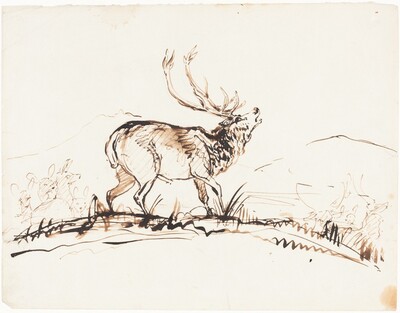
Sir Edwin Landseer (1802-1873) was an English painter known for his animal subjects, particularly his dogs and stags, rendered with the narrative skill and anatomical precision that made him one of the most popular painters in Victorian England. Lion Defending its Prey from c. 1840 depicts a lion defending its kill in the dramatic, narrative manner that Landseer applied to his animal subjects. The lion subject allowed Landseer to exercise his talent for dramatic composition and anatomical precision in a format larger than his more familiar dog and stag subjects.
Cultural Impact
Lion Defending its Prey is important in Landseer's oeuvre because it demonstrates the dramatic narrative skill that he applied to his animal subjects in a format larger than his more familiar small-scale paintings. The lion subject shows Landseer applying the narrative composition and anatomical precision that made his dog and stag paintings so popular to a subject that is simultaneously exotic and dramatic—qualities that Victorian audiences found irresistible.
Why It Matters
Lion Defending its Prey is Landseer's dramatic animal narrative at large scale: a lion defending its kill rendered with the narrative composition and anatomical precision that made him the most popular animal painter in Victorian England. The c. 1840 painting shows Landseer applying his proven formula to a larger and more exotic subject.
![Contending Group after Nature [A Lion Fighting a Tiger and a Leopard]](https://api.nga.gov/iiif/493ccbcb-1c3e-4a38-9d07-1cdc727c0639/full/400,/0/default.jpg)