Provenance
Odilon Redon [1840-1916], Paris; his son, Ari Redon [1889-1972], Paris. (Galerie Jacques Rodrigues-Henriques, Paris). Georges Lévy, Paris, in 1937.[1] private collection, Paris, in 1957.[2] Paul Mellon [1907-1999], Upperville, Virginia; bequest 1999 to NGA, with life interest to his wife, Rachel Lambert Mellon [1910-2014].
[1] The painting was exhibited at Seligmann’s in Paris in 1938. In 1937, Lévy was selling through Seligmann two Renoirs now in the collection of the NGA (1956.4.1-2) so it is possible he sold the Seurat through Seligmann as well. However, to date no documents concerning the Seurat have been discovered in the records of Jacques Seligmann and Co. at the Archives of American Art, Washington, D.C.
[2] Lent from a private collection in Paris to _Seurat_, Musée Jacquemart-Andre, Paris, 1957, no. 6.
Accession Number
2014.18.48
Medium
oil on wood
Dimensions
overall: 15.56 × 24.77 cm (6 1/8 × 9 3/4 in.)
Classification
Painting
Credit Line
Collection of Mr. and Mrs. Paul Mellon
Tags
Painting Impressionist & Modern (1851–1900) Oil Painting French
Background & Context
Background Story
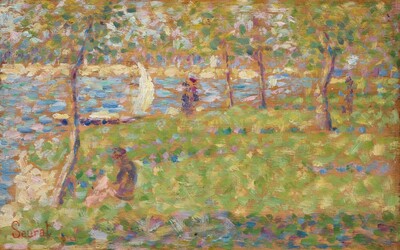
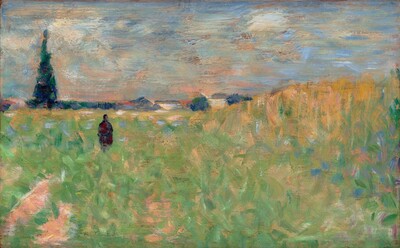
Haymakers at Montfermeil is one of Seurat's earliest independent works, painted when he was about twenty-three and still under the direct influence of Impressionism. The rural subject — laborers in a field near the village of Montfermeil, east of Paris — shows Seurat working squarely within the landscape tradition of Corot, Millet, and the Barbizon School, but with a brighter palette and more broken brushwork that reveal his study of Monet and Pissarro. The composition is simple and horizontal, with the figures integrated into the landscape rather than dominating it.
Cultural Impact
This painting shows Seurat before Seurat — before the dot, before the science, before the theoretical framework that would transform him into the leader of Neo-Impressionism. And yet the fundamental concerns are already present: the careful tonal relationships, the structured composition, the interest in working people as subjects rather than decorative figures. The haymakers are not romanticized peasants; they are workers observed with respect and precision.
Why It Matters
Haymakers at Montfermeil is the starting point for understanding Seurat. Here we see the Impressionist foundation upon which he would build an entirely new way of painting. The journey from this canvas to La Grande Jatte is the story of modernism's first great systematic revolution.