Provenance
The artist [1857-1891], until his death.[1] Jacques and Pierre Puybonnieux, Paris, until 1956.[2] (Wildenstein, Paris). Paul Mellon [1907-1999], Upperville, Virginia, by 1958;[3] bequest 1999 to NGA, with life interest to his wife, Rachel Lambert Mellon [1910-2014].
[1] Atelier Seurat, posthumous inventory, no. 58.
[2] Jacques and Pierre Puybonnieux were the sons of Marie Puybonnieux, Seurat’s cousin, who probably inherited the painting from Seurat’s mother. They were probably the lenders to the 1933 Paris exhibition _Seurat et Ses Amis_, as they did lend a small panel formerly in the Adele and Arthur Lehman collection.
[3] Lent to _Seurat Paintings and Drawings_, The Art Institute of Chicago, The Museum of Modern Art, New York, 1958, no. 30, as _Peasant at Work_.
Accession Number
2014.18.49
Medium
oil on wood
Dimensions
overall: 14.61 × 24.13 cm (5 3/4 × 9 1/2 in.)
Classification
Painting
Credit Line
Collection of Mr. and Mrs. Paul Mellon
Tags
Painting Impressionist & Modern (1851–1900) Oil Painting French
Background & Context
Background Story
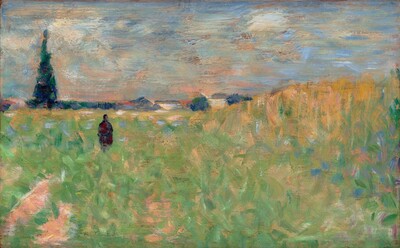
This small panel of a solitary agricultural laborer demonstrates Seurat's early engagement with rural working-class subjects — a theme he shared with his hero Millet but treated with a cooler, more observational eye. The peasant is seen from behind, bent over the soil, reduced almost to a geometric form against the horizontal bands of field and sky. This simplification of the human figure into a sculptural mass in a landscape would become Seurat's compositional signature, even after his technique transformed into Pointillism.
Cultural Impact
Seurat's choice of a peasant with a hoe as a subject in 1882 connects him to the Realist tradition of Millet and Courbet, but his treatment departs from theirs in crucial ways. Where Millet idealizes and Courbet monumentalizes, Seurat observes. The figure is integrated into the landscape as one vertical element among many horizontals — a compositional strategy that anticipates the rhythmic structure of La Grande Jatte.
Why It Matters
Peasant with a Hoe shows that Seurat's radical compositional thinking was present from the very beginning. The reduction of the human figure to a structural element in a landscape design is the foundation upon which his entire revolution was built.