Provenance
Purchased from the artist 15 December 1923 by the Corcoran Gallery of Art, Washington; acquired 2014 by the National Gallery of Art.
Accession Number
2014.79.45
Medium
oil on canvas
Dimensions
overall: 82.6 × 108 cm (32 1/2 × 42 1/2 in.) | framed: 94 × 119.4 × 5.7 cm (37 × 47 × 2 1/4 in.)
Classification
Painting
Credit Line
Corcoran Collection (Museum Purchase, William A. Clark Fund)
Tags
Painting Early Modern (1901–1950) Oil Painting Canvas American
Background & Context
Background Story
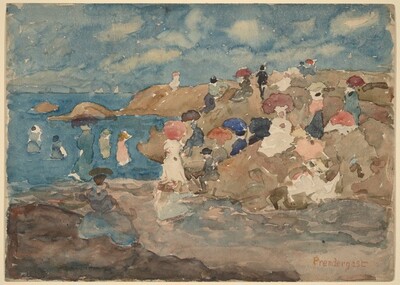
Maurice Prendergast (1858-1924) was an American painter known for his mosaic-like paintings of crowds in parks and on beaches that combine the decorative pattern of Post-Impressionism with the American subject of leisure. Landscape with Figures from 1921 depicts figures in a landscape in the mosaic-like, decorative manner that distinguishes Prendergast's mature work. The 1921 date places this in Prendergast's late period, when he had fully developed the mosaic-like manner that makes his paintings among the most decorative in American art, and the landscape with figures subject allows him to exercise his talent for combining decorative pattern with figural composition.
Cultural Impact
Landscape with Figures is important in Prendergast's late oeuvre because it demonstrates the mosaic-like, decorative manner that he had fully developed by the 1920s. The 1921 painting shows Prendergast combining the decorative pattern of Post-Impressionism with the American subject of leisure in a manner that is simultaneously decorative and figural—a combination that makes his paintings among the most distinctive in American art.
Why It Matters
Landscape with Figures is Prendergast's mosaic-like decoration at its most mature: figures in a landscape rendered in the decorative, patterned manner that makes his paintings the most distinctive in American art. The 1921 painting shows the fully developed mosaic-like manner that combines Post-Impressionist decoration with American leisure.