Provenance
Roussel, Paris, by 1905.[1] (Roussel collection sale, Galerie Georges Petit, Paris, 25-28 March 1912, no. 28); (Arnold & Tripp, Paris).[2] (John Levy Galleries, New York); purchased 1919 by William A. Clark [1839-1925], New York;[3] bequest 1926 to the Corcoran Gallery of Art, Washington; acquired 2014 by the National Gallery of Art.
[1] Alfred Robaut lists the painting as in the Roussel collection in _L'Oeuvre de Corot_, 5 vols., Paris, 1905: 3:168, no. 1698, repro.
[2] "Sen. Clark's New Corot," _American Art News_ 8, no. 9 (20 December 1919): 1.
[3] "Another Corot for Clark," _American Art News_ 8, no. 10 (27 December 1919): 1.
Accession Number
2014.136.25
Medium
oil on canvas
Dimensions
overall: 55.88 × 80.01 cm (22 × 31 1/2 in.) | framed: 87.63 × 112.4 × 11.43 cm (34 1/2 × 44 1/4 × 4 1/2 in.)
Classification
Painting
Credit Line
Corcoran Collection (William A. Clark Collection)
Tags
Painting Impressionist & Modern (1851–1900) Oil Painting Canvas French
Background & Context
Background Story
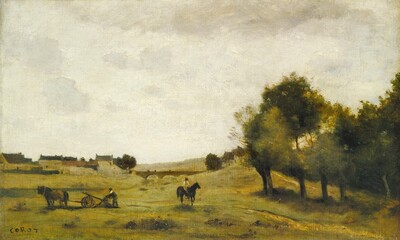
Dance under the Trees at the Edge of the Lake (1865/1870) combines two of Corot's most characteristic subjects—figures in a landscape and the silvery tonalities of his mature style. The dance, a communal activity that connected rural communities across Europe, provided Corot with a subject that combined figure painting with the pastoral landscape tradition. The 1865-70 date places this during Corot's most productive late period, when his landscape method was at its most poetic and his figure subjects were at their most animated. The dancers, moving beneath trees at the edge of a lake, represent the harmony between human activity and natural beauty that Corot's art consistently pursued. His treatment of the dancing figures—rendered with the same silvery tonality and soft brushwork that characterized his landscape handling—integrates human movement into the landscape's atmospheric unity rather than setting the figures against their natural setting. The lake, reflecting the sky and the trees, creates the luminous depth that was Corot's greatest technical achievement, and the dancers at its edge become elements within this luminous space rather than figures placed before a scenic backdrop. The painting's combination of genre subject and landscape poetry represents Corot's art at its most characteristic and appealing.
Cultural Impact
Corot's dance paintings influenced how communal rural activities were represented in French art, combining genre observation with landscape poetry. The paintings influenced later artists who similarly found subjects in the harmony between human activity and natural beauty—from Renoir's Dance at Bougival to Matisse's Dance. The dance-under-trees subject influenced how the pastoral tradition was updated for the 19th century, connecting classical pastoral to contemporary rural life.
Why It Matters
This painting matters because it represents the synthesis of Corot's two greatest gifts—the atmospheric landscape and the animated figure—within a single composition where neither element dominates. The dancers and the lake exist in the same atmospheric space, arguing that human activity and natural beauty are not opposites but aspects of a single harmonious experience that art can reveal.