Provenance
The artist [1852-1919]; purchased December 1918 by George M. Oyster, Jr. [1849-1921], Washington;[1] his estate; bequest 21 January 1924 to the Corcoran Gallery of Art, Washington; acquired 2015 by the National Gallery of Art.
[1] Letter, 4 December 1918, Oyster to C. Powell Minnigerode, Corcoran director; copy in NGA curatorial files.
Accession Number
2015.19.14
Medium
oil on canvas
Dimensions
painted surface: 60.8 × 84.77 cm (23 15/16 × 33 3/8 in.) | overall: 61.38 × 85.73 cm (24 3/16 × 33 3/4 in.) | framed: 91.44 × 118.11 × 15.24 cm (36 × 46 1/2 × 6 in.)
Classification
Painting
Credit Line
Corcoran Collection (Bequest of George M. Oyster, Jr.)
Tags
Painting Early Modern (1901–1950) Oil Painting Canvas American
Background & Context
Background Story
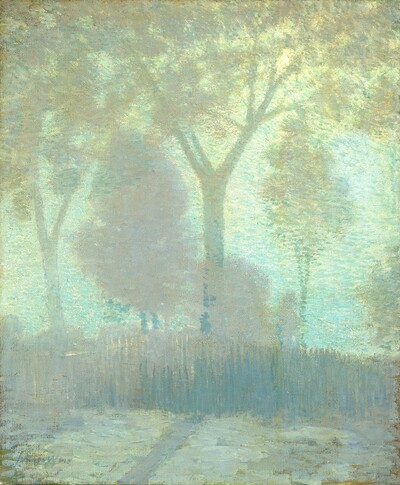
Julian Alden Weir (1852-1919) was an American painter known for his Impressionist landscapes and still lifes that combine the tonal manner of his early training with the Impressionist bright palette he adopted in the 1890s. Obweebetuck from c. 1908 depicts a landscape near Weir's Connecticut home in the Impressionist manner that he had fully developed by the early 20th century. The c. 1908 date places this in Weir's mature period, when he was producing the Impressionist landscapes that are his most accomplished works, and the Connecticut landscape subject is characteristic of his most productive years.
Cultural Impact
Obweebetuck is important in Weir's mature oeuvre because it demonstrates the Impressionist manner that he had fully developed by the early 20th century. The Connecticut landscape subject is characteristic of Weir's most productive years, and the c. 1908 painting shows the fully developed Impressionist manner that he brought to the American landscape tradition.
Why It Matters
Obweebetuck is Weir's mature Connecticut Impressionism: a landscape near his home rendered in the fully developed Impressionist manner that he brought to the American landscape tradition. The c. 1908 painting shows Weir's mature Impressionist manner at its most accomplished.