Provenance
The artist; sold 1857 to Robert M. Olyphant [1824-1918], New York;[1] (his sale, by Robert Somerville at Chickering Hall, New York, 18-19 December 1877, 1st day, no. 65, as _High Bank, Genessee River_); purchased through (Samuel P. Avery, New York) by Corcoran Gallery of Art, Washington;[2] acquired 2014 by the National Gallery of Art.
[1] Titled _View on the Genesee_, the painting is recorded in a "list of all paintings sold with prices and to whom sold" for the year 1857 (John F. Kensett Papers, Kellogg Collection, Archives of American Art, Smithsonian Institution, Washington: Microfilm N68-85, frame 477; copy in NGA curatorial files).
[2] According to the Register of Paintings Belonging to the Corcoran Gallery of Art, 1869-1946, the painting was received from Avery on 26 December 1877 (Series 1, Box: 135, Volume: 1. Corcoran Gallery of Art and Corcoran College of Art + Design, Corcoran Gallery of Art registrar's office records, COR0005.1-RG. Special Collections Research Center, The George Washington University; digitized online and copy in NGA curatorial files). That he was acting as agent for the Corcoran Gallery at the Olyphant sale is suggested by an annotated copy of the auction catalogue in which the buyer of the painting is listed as the Corcoran. (_Catalogue, Mr. Robert M. Olyphant's collection of paintings by American artists_, New York: Somerville Art Gallery, 1877, Metropolitan Museum of Art, Thomas J. Watson.) The Corcoran register lists six paintings from the Olyphant sale received from Avery.
Accession Number
2014.136.118
Medium
oil on canvas
Dimensions
overall: 76.2 × 123.83 cm (30 × 48 3/4 in.) | framed: 118.75 × 163.83 × 17.46 cm (46 3/4 × 64 1/2 × 6 7/8 in.)
Classification
Painting
Credit Line
Corcoran Collection (Museum Purchase, Gallery Fund)
Tags
Painting Impressionist & Modern (1851–1900) Oil Painting Canvas American
Background & Context
Background Story
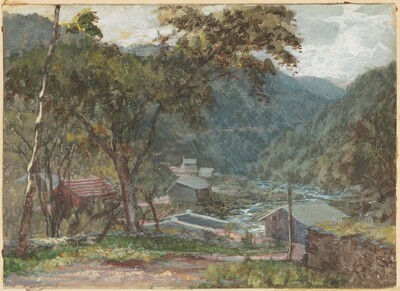
View on the Genesee near Mount Morris (1857) depicts the Genesee River valley in western New York—a landscape that was rapidly being transformed by agricultural development and settlement. The Genesee Valley, with its fertile soil and dramatic river gorge, was one of the first areas of western New York to be settled after the Erie Canal opened in 1825. By 1857, the valley was productive farmland, and Kensett's painting likely balances the landscape's natural features—river, gorge, forest—with the evidence of agricultural development that was reshaping it. Mount Morris, at the southern end of the Genesee River's dramatic gorge (now Letchworth State Park), provided a viewpoint that combined river drama with pastoral beauty—exactly the combination that Hudson River School painters sought. Kensett's Luminist treatment brings his characteristic clarity to the western New York landscape, creating a scene of serene beauty that transcends the specific topography while remaining faithful to it. The year 1857 was a productive one for Kensett, and this painting represents one of his more ambitious compositions—expanding beyond the intimate coastal and lake subjects that dominated his work to encompass a larger river valley.
Cultural Impact
Kensett's Genesee Valley paintings influenced how western New York was represented in American art, contributing to the cultural recognition of the region's landscape beauty. The paintings influenced tourism for the Genesee Valley and the future Letchworth State Park. Kensett's approach to river valley landscape influenced later American painters who similarly sought to balance natural beauty with agricultural development in their compositions.
Why It Matters
This painting matters because it captures a specific American landscape in transition—the Genesee Valley at the moment when agricultural development was transforming wilderness into productive farmland. Kensett's painting neither celebrates nor laments this transformation; instead, it presents the landscape's beauty regardless of its state of development—suggesting that aesthetic value persists through environmental change.