Provenance
(The Old Print Shop, New York); purchased February 1957 by the Corcoran Gallery of Art, Washington; acquired 2014 by the National Gallery of Art.
Accession Number
2014.136.76
Medium
oil on canvas
Dimensions
overall: 48.9 × 59.69 cm (19 1/4 × 23 1/2 in.) | framed: 60.96 × 73.66 cm (24 × 29 in.)
Classification
Painting
Credit Line
Corcoran Collection (Museum Purchase through a gift of Josephine Boardman Crane)
Tags
Painting Impressionist & Modern (1851–1900) Oil Painting Canvas American
Background & Context
Background Story
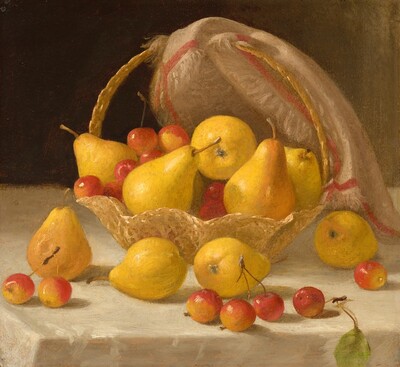
John F. Francis (1808-1886) was an American still life painter known for his precisely observed fruit and dessert still lifes in the lavish manner that distinguishes the best American still life painting of the mid-19th century. Still Life with Silver Cake Basket from 1866 depicts fruit and a silver cake basket in the precisely observed, lavish manner that distinguishes Francis's best work. The 1866 date places this in Francis's most productive period, when he was producing the fruit and dessert still lifes that are his most accomplished works, and the silver cake basket demonstrates the combination of American still life with the luxury objects that distinguish the most accomplished mid-19th-century American still life.
Cultural Impact
Still Life with Silver Cake Basket is important in the history of American still life painting because it demonstrates the lavish manner that distinguishes the best mid-19th-century American still life. Francis's combination of precisely observed fruit with luxury objects like the silver cake basket shows the American still life tradition at its most accomplished—simultaneously precise in observation and lavish in display.
Why It Matters
Still Life with Silver Cake Basket is Francis's lavish American still life: fruit and silver rendered with the precise observation and lavish display that distinguish the best mid-19th-century American still life. The 1866 painting shows American still life at its most accomplished—simultaneously precise and lavish.