Provenance
George Catlin [1796-1872]; by descent to his daughters, Clara Gregory Catlin, Louise Catlin Kinney, and Elizabeth Wing Catlin; purchased 1912 from Elizabeth Wing Catlin by the American Museum of Natural History; sold 1959 through (Kennedy Galleries, New York) to Mr. Paul Mellon, Upperville, VA; gift 1965 to the NGA.
Accession Number
1965.16.41
Medium
oil on card mounted on paperboard
Dimensions
overall: 45.7 x 62.2 cm (18 x 24 1/2 in.)
Classification
Painting
Credit Line
Paul Mellon Collection
Tags
Painting Impressionist & Modern (1851–1900) Oil Painting Board American
Background & Context
Background Story
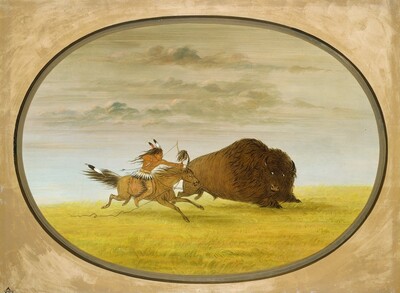
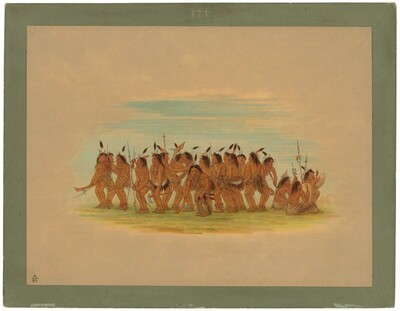
George Catlin (1796-1872) was the most important painter of Native American life in the 19th century, producing a vast archive of portraits and scenes that documented the cultures of tribes that were being displaced by westward expansion. A Small Cheyenne Village from the 1861-69 period is a late work, depicting a Cheyenne settlement with the documentary precision that characterizes all of Catlin's ethnographic paintings. The small format (oil on card mounted on paperboard) and the late date suggest that this was painted from memory or earlier sketches rather than from direct observation, as Catlin's major fieldwork among the Plains tribes had been completed in the 1830s.
Cultural Impact
Catlin's late paintings of Native American life are important because they document the cultures of tribes that had already been fundamentally transformed by the westward expansion that Catlin himself had witnessed. A Small Cheyenne Village from the 1860s is a record of a way of life that was being destroyed even as Catlin painted it, making his documentary paintings both an invaluable ethnographic record and a poignant reminder of the cultural cost of American expansion.
Why It Matters
A Small Cheyenne Village is Catlin's late ethnographic record of a disappearing way of life: a Cheyenne settlement documented with the care of an ethnographer and the sadness of a witness who knows the culture is being destroyed. The 1861-69 date makes this a memorial as well as a document—a record of what was being lost even as it was being painted.