Provenance
George Catlin [1796-1872]; by descent to his daughters, Clara Gregory Catlin, Louise Catlin Kinney, and Elizabeth Wing Catlin; purchased 1912 from Elizabeth Wing Catlin by the American Museum of Natural History; sold 1959 through (Kennedy Galleries, New York) to Mr. Paul Mellon, Upperville, VA; gift 1965 to the NGA.
Accession Number
1965.16.64
Medium
oil on card mounted on paperboard
Dimensions
overall: 47.3 x 62.8 cm (18 5/8 x 24 3/4 in.)
Classification
Painting
Credit Line
Paul Mellon Collection
Tags
Painting Impressionist & Modern (1851–1900) Oil Painting Board American
Background & Context
Background Story
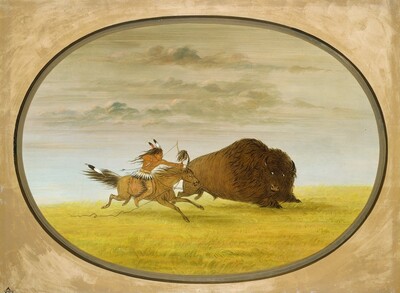
Pawnee Indians Approaching Buffalo from the 1861-69 period is a late Catlin depicting one of his most characteristic subjects: the buffalo hunt, which was the central economic and spiritual activity of the Plains tribes. Catlin had witnessed and painted buffalo hunts during his fieldwork in the 1830s, and this late version is likely derived from earlier sketches and memories rather than from direct observation. The Pawnee were one of the most important Plains tribes, and their buffalo hunting culture was already being transformed by the near-extinction of the buffalo that would be completed by the 1880s.
Cultural Impact
Catlin's buffalo hunt paintings are among the most important visual documents of Plains Indian culture because they record an activity—the communal buffalo hunt—that was central to the economic, spiritual, and social life of the Plains tribes and that was being destroyed by the systematic extermination of the buffalo. The Pawnee Indians Approaching Buffalo from the 1860s is a record of a hunt that would soon become impossible, making it both an ethnographic document and a memorial.
Why It Matters
Pawnee Indians Approaching Buffalo is Catlin documenting the activity that defined Plains Indian culture: the communal buffalo hunt, recorded in the 1860s as the buffalo were being systematically exterminated. The painting is simultaneously an ethnographic document and a memorial—a record of a hunt that would soon become impossible.