Provenance
(Julius Oehme Gallery, New York); F.L. Loring; (his sale, American Art Association, New York, 16-17 January 1917, no. 124). (Ralston Galleries, New York).[1] William A. Clark [1839-1925]; bequest 1926 to the Corcoran Gallery of Art, Washington; acquired 2014 by the National Gallery of Art.
[1] According to an annotation in the Loring sale catalogue.
Accession Number
2014.136.23
Medium
oil on canvas
Dimensions
overall: 65.41 × 81.92 cm (25 3/4 × 32 1/4 in.) | framed: 92.71 × 109.22 × 13.34 cm (36 1/2 × 43 × 5 1/4 in.)
Classification
Painting
Credit Line
Corcoran Collection (William A. Clark Collection)
Tags
Painting Impressionist & Modern (1851–1900) Oil Painting Canvas French
Background & Context
Background Story
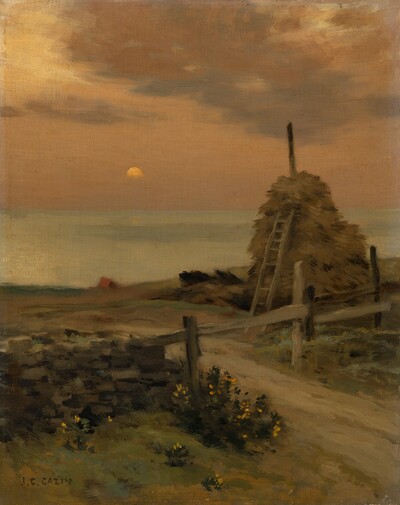
The combination of homestead and sea is fundamental to Cazin's art — he lived and worked near Boulogne-sur-Mer, where the coastal landscape provided endless variations on the theme of rural life alongside maritime weather. In this painting, the homestead is not a picturesque cottage but a working farmhouse, its solid forms providing a counterpoint to the restless sea beyond. The composition is organized along the horizontal: the flat coastal plain, the low buildings, and the sea form three bands that echo the structure of the sky above.
Cultural Impact
Cazin's coastal paintings occupy a distinctive position in French landscape art. Where the Impressionists painted the sea for its light and color, Cazin painted it for its weather and mood. His sea is often overcast or just clearing, his sky often heavy — the atmospheric conditions of the Pas-de-Calais, where the English Channel meets the French coast with particular force.
Why It Matters
Homestead by the Sea is Cazin's northern France in miniature: a working landscape where the farm meets the sea, and both are painted with the tonal subtlety and structural clarity that distinguish the best French naturalist painting from mere observation.