Provenance
William B. Norman [d. 1906];[1] sold 1899 to (Durand-Ruel et Cie, Paris and New York). Edward C. [d. 1915] and Mary Griffin [1855-1937] Walker, Willistead Manor, Walkerville, Ontario, and Washington, by 1905;[2] bequest 4 May 1937 to the Corcoran Gallery of Art, Washington; acquired 2015 by the National Gallery of Art.
[1] Norman, a well-known auctioneer, established the Fifth Avenue Auction Galleries in 1883, and later the Tiffany Studios.
[2] The painting was included in a 1905 exhibition of the Walker collection at the Detroit Museum of Art.
Accession Number
2015.19.58
Medium
oil on canvas
Dimensions
overall: 52.39 × 72.87 cm (20 5/8 × 28 11/16 in.) | framed: 83.19 × 103.51 × 10.8 cm (32 3/4 × 40 3/4 × 4 1/4 in.)
Classification
Painting
Credit Line
Corcoran Collection (Edward C. and Mary Walker Collection)
Tags
Painting Impressionist & Modern (1851–1900) Oil Painting Canvas French
Background & Context
Background Story
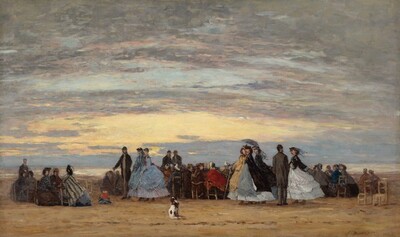
Le Havre (1883) depicts the port city where Boudin grew up and where Monet was raised—a city whose maritime character profoundly influenced both artists' development. Le Havre, France's largest commercial port after Marseille, was a city of ships, warehouses, and the international commerce that flowed through its docks. Boudin's 1883 painting captures the port at a moment of transition: steam was replacing sail, and the port's character was changing as modern shipping technology transformed its operations. The year 1883 was significant for both Boudin and art history: Monet, who had grown up in Le Havre, was living at Giverny and developing the serial method, and Boudin was continuing to paint the port that had shaped them both. Boudin's treatment of Le Havre likely emphasizes the harbor's visual character—vessels, cranes, warehouses, and the atmospheric conditions that defined the port's appearance—rather than documenting its commercial operations. His Le Havre paintings connect the city's industrial function to the atmospheric beauty of the Seine estuary, where river, sea, and sky create the luminous conditions that inspired both Boudin and his protégé Monet. The painting also documents Le Havre at a specific moment in its development—before the destruction of World War II would transform the city's architecture.
Cultural Impact
Boudin's Le Havre paintings influenced how French commercial ports were represented in art, documenting the transition from sail to steam. The paintings influenced how the city was perceived culturally, establishing its visual identity as a place of both industrial activity and atmospheric beauty. The Le Havre subject also influenced how Monet's artistic origins were understood—the port city that produced the founder of Impressionism.
Why It Matters
This painting matters because it depicts the city that produced both Boudin and Monet—the port whose maritime character shaped the sensibility that would create Impressionism. Boudin's Le Havre is not merely a city view; it is a portrait of the environment that made outdoor, atmospheric painting both possible and necessary.