Provenance
The artist [1860-1932]; purchased 22 January 1911 by the Corcoran Gallery of Art, Washington; acquired 2015 by the National Gallery of Art.
Accession Number
2015.19.3
Medium
oil on canvas
Dimensions
overall: 136.37 × 126.05 cm (53 11/16 × 49 5/8 in.) | framed: 167.96 × 160.02 × 13.34 cm (66 1/8 × 63 × 5 1/4 in.)
Classification
Painting
Credit Line
Corcoran Collection (Museum Purchase, Gallery Fund)
Tags
Painting Early Modern (1901–1950) Oil Painting Canvas American
Background & Context
Background Story
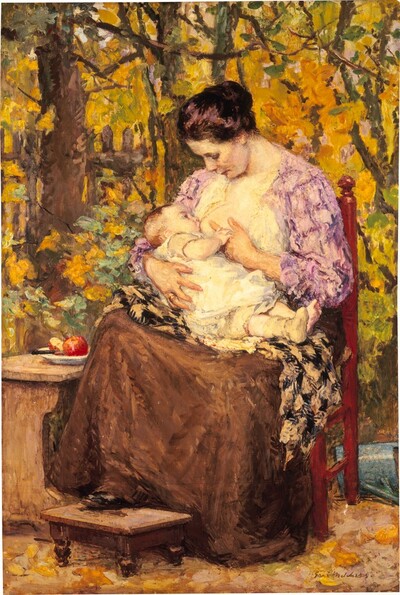
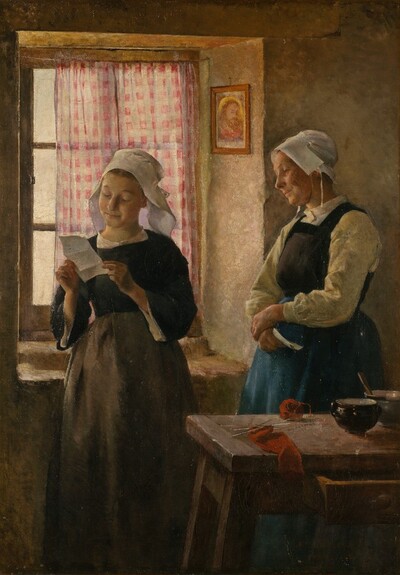
Gari Melchers (1860-1932) was an American painter known for his cosmopolitan subjects rendered in the solidly modeled, naturalistic manner that he developed during his years of study and work in Europe. Penelope from 1910 depicts the mythological subject of Penelope, the wife of Odysseus who waited faithfully for her husband's return, in the solidly modeled, naturalistic manner that distinguishes Melchers's best work. The 1910 date places this in Melchers's mature period, when he was combining the European training he had received in Paris and Holland with American subjects and themes.
Cultural Impact
Penelope is important in Melchers's mature oeuvre because it demonstrates the solidly modeled, naturalistic manner that he developed during his European training and applied to both American and European subjects. The mythological subject of Penelope allows Melchers to combine the naturalistic treatment he learned in Europe with a subject that has both classical and personal resonance, creating a type of painting that is simultaneously classical in subject and naturalistic in manner.
Why It Matters
Penelope is Melchers's naturalistic mythological painting: the faithful wife of Odysseus rendered in the solidly modeled, naturalistic manner that he developed during his European training. The 1910 painting combines classical subject with naturalistic treatment in the cosmopolitan manner that distinguishes Melchers's best work.