Provenance
The artist [1859-1935]; purchased 1920 by George M. Oyster, Jr. [1849-1921], Washington;[1] his estate; bequest 21 January 1924 to the Corcoran Gallery of Art, Washington; acquired 2015 by the National Gallery of Art.
[1] Oyster probably purchased the painting from the Corcoran's 1919-1920 _Seventh Exhibition: Oil Paintings by Contemporary American Artists_.
Accession Number
2015.19.15
Medium
oil on canvas
Dimensions
overall: 81.92 × 100.33 cm (32 1/4 × 39 1/2 in.) | framed: 107.32 × 125.73 × 10.16 cm (42 1/4 × 49 1/2 × 4 in.)
Classification
Painting
Credit Line
Corcoran Collection (Bequest of George M. Oyster, Jr.)
Tags
Painting Early Modern (1901–1950) Oil Painting Canvas American
Background & Context
Background Story
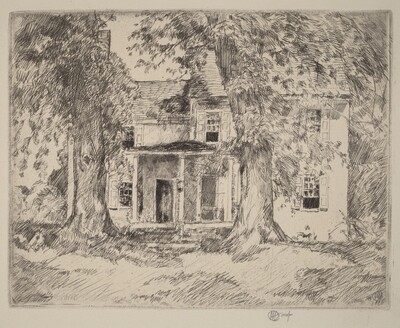
Old House at East Hampton (1916) depicts one of the historic houses of East Hampton, Long Island—a community that Hassam visited and painted repeatedly. East Hampton's architectural heritage—17th and 18th-century houses that survived the region's modernization—attracted artists who valued the visual character of old New England. The painting likely presents the house nestled in its landscape, its shingled exterior and traditional form contrasting with the modernizing Hamptons that were beginning to attract wealthy summer residents. The year 1916 places this work during World War I, when American identity and heritage were being strongly asserted. Hassam's choice to paint an old house rather than a new development carries a cultural message: the value of preserving American architectural heritage against the spread of suburban development. Hassam's technique—loose but controlled Impressionist brushwork—renders the house's weathered textures and the surrounding landscape's lushness with equal attention. The work also reflects Hassam's growing interest in American historical subjects, which would intensify during and after World War I as he produced his famous Flag series celebrating Allied unity.
Cultural Impact
Hassam's East Hampton paintings influenced how American architectural heritage was represented and valued in art, contributing to the historic preservation movement that would gain momentum in the 1920s and beyond. The paintings influenced how the Hamptons were perceived culturally—not just as a summer playground but as a region with deep historical roots and distinctive visual character. The work also influenced American Impressionism's development by demonstrating that American historical subjects could be served by Impressionist technique.
Why It Matters
This painting matters because it captures a moment of cultural transition: the old East Hampton was giving way to the new, and Hassam's painting records the visual character of traditional Long Island architecture before development transformed the landscape. For contemporary audiences facing similar transitions, the painting demonstrates that documenting threatened heritage is itself an artistic act of preservation.