Provenance
Private Collection, Paris. (Théodore Bonjean, Paris);[1] purchased 20 May 1911 by (M. Knoedler & Co., New York); Knoedler sold half-share to (P. & D. Colnaghi & Co.);[2] purchased October 1922 by William A. Clark [1839-1925], New York;[3] bequest 1926 to the Corcoran Gallery of Art, Washington; acquired 2015 by the National Gallery of Art.
[1] Early provenance according to Knoedler. See M. Knoedler & Co. Records, accession number 2012.M.54, Research Library, Getty Research Institute, Los Angeles: Painting Stockbook 5, 8800-12652, 1899 April-1911 December, page 243, the painting is stock number 12569.
[2] The first mention of joint-ownership with Colnaghi is dated 30 April 1912. See M. Knoedler & Co. Records, accession number 2012.M.54, Research Library, Getty Research Institute, Los Angeles: Painting Stockbook 6, 12653-15139, 1911 December-1920 July, page 21.
[3] See See M. Knoedler & Co. Records, accession number 2012.M.54, Research Library, Getty Research Institute, Los Angeles: Painting Stockbook 7, 15140-17039, 1921 January-1927 December, page 2.
Accession Number
2015.19.29
Medium
oil on canvas
Dimensions
overall: 32.39 × 52.71 cm (12 3/4 × 20 3/4 in.) | framed: 48.9 × 68.9 × 6.99 cm (19 1/4 × 27 1/8 × 2 3/4 in.)
Classification
Painting
Credit Line
Corcoran Collection (William A. Clark Collection)
Tags
Painting Neoclassical & Romantic (1751–1850) Oil Painting Canvas Italian
Background & Context
Background Story
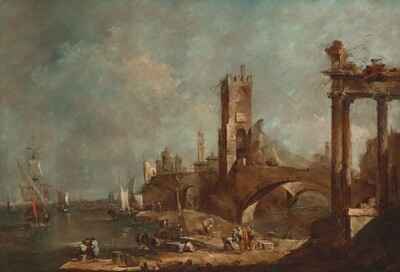
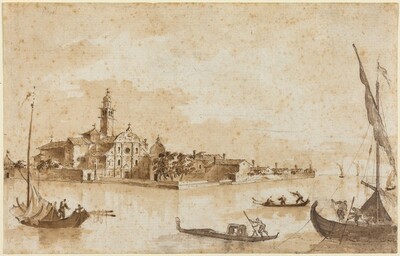
Guardi's depiction of Santa Maria della Salute, painted around 1770, presents Venice's most iconic Baroque church as seen from across the water, its great domes rising above the Bacino di San Marco. The church, designed by Baldassare Longhena and completed in 1681, was built as a votive offering after Venice survived the devastating plague of 1629-1631. Guardi positions the viewer at water level, emphasizing the church's dramatic silhouette against the sky while the canal before it teems with boats and activity. This low viewpoint amplifies the Basilica's monumentality while integrating it into the daily life of the lagoon. Unlike Canaletto's precise architectural renderings of the same church, Guardi's Santa Maria della Salute dissolves architectural detail into atmosphere. The domes and volutes are suggested rather than delineated; the marble surfaces shimmer in reflected light; the water reflects and fragments the building's mass. By the 1770s, veduta painting had become Venice's most successful artistic export, collected by Grand Tour travelers across Europe. Guardi's more painterly approach appealed to collectors who sought not just topographical records but works of artistic sensibility.
Cultural Impact
The Santa Maria della Salute became perhaps the most depicted building in Venetian art, its distinctive silhouette appearing in works by Canaletto, Turner, Monet, and countless photographers. Guardi's version influenced how the building was perceived—not as an architectural monument alone but as a living presence within Venice's watery environment. The image shaped later artists' approaches to depicting buildings within landscape, prioritizing atmospheric integration over architectural precision.
Why It Matters
This work matters because it demonstrates how iconic architecture can be rendered as experience rather than object. Guardi's Santa Maria della Salute is not a building depicted; it is a building perceived—felt through atmosphere, light, and water. This approach influenced the entire tradition of atmospheric architectural painting that developed in the 19th and 20th centuries.