Provenance
Commissioned by the Société des Amis des Arts de Douai through (Alfred Robaut); returned to the artist; (Hector Brame, Paris); Paul Gallimard [1850-1929], by 1900.[1] (Galerie Georges Petit, Paris);[2] purchased 18 February 1919 by (M. Knoedler and Co., New York); sold January 1920 to William A. Clark [1839-1925]; bequest 1926 to the Corcoran Gallery of Art, Washington; acquired 2014 by the National Gallery of Art.
[1] Gallimard lent the painting to the _Exposition Universelle de 1900_, no. 30.
[2] The painting is stock number 14620 in the M. Knoedler & Co. Records, accession number 2012.M.54, Research Library, Getty Research Institute, Los Angeles: Stock book 6, 12653-15139, 1911 December-1920 July, p. 188.
Accession Number
2014.136.26
Medium
oil on canvas
Dimensions
overall: 66.04 × 81.28 cm (26 × 32 in.) | framed: 91.76 × 107.63 × 8.57 cm (36 1/8 × 42 3/8 × 3 3/8 in.)
Classification
Painting
Credit Line
Corcoran Collection (William A. Clark Collection)
Tags
Painting Impressionist & Modern (1851–1900) Oil Painting Canvas French
Background & Context
Background Story
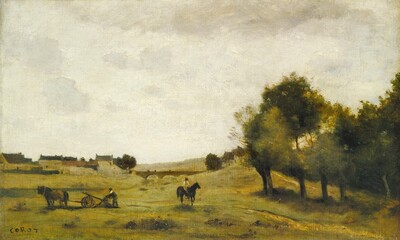
Souvenir of Terracina (1864, reworked slightly later) represents Corot's practice of composing Italian landscape subjects in his Paris studio from memory—a method that produced some of his most celebrated works. Terracina, a town on the coast between Rome and Naples, provided the kind of Mediterranean landscape—coastal cliffs, distant mountains, and the particular quality of Italian light—that had captivated Corot during his visits to Italy. The word souvenir in the title specifies the painting's relationship to its subject: this is not a topographical record of Terracina but a memory of it, filtered through the artistic imagination and composed according to the aesthetic principles that Corot's mature style demanded. The year 1864 and subsequent reworking demonstrate Corot's practice of revisiting and refining his compositions—the painting was not a spontaneous transcription but a carefully constructed image that developed over time. This distinction between direct observation and memory-based composition was fundamental to Corot's art and to the influence he exerted on later landscape painting: the Impressionists would take his outdoor method in one direction, while the Symbolists would take his memory-based method in another. The painting's silvery tonal unity—the characteristic Corot atmosphere—transforms Terracina's specific landscape into a poetic realm where sunlight and shadow exist in perpetual harmony.
Cultural Impact
Corot's Souvenir paintings influenced how memory-based landscape composition was practiced in French art, establishing a tradition of studio composition from remembered experience that influenced both the Impressionists and the Symbolists. The Italian souvenir subject influenced how Italy was represented in French landscape painting, contributing to the idealized vision of the Italian landscape that was a staple of French artistic culture. The reworking practice influenced how studio painting was understood, connecting compositional refinement to artistic quality.
Why It Matters
This painting matters because it demonstrates the distinction between observation and memory that was fundamental to Corot's art—the difference between recording what is seen and composing what is remembered. Souvenir of Terracina is not Terracina as it appeared to Corot but Terracina as he carried it in his artistic imagination, and this distinction between seen and remembered reality is one of the most important conceptual contributions that 19th-century painting made to the history of art.