Provenance
Richter Oelrich, Bremen, c. 1820; purchased 1928 by Bernhard Hausmann [1784-1873], Hanover;[1] private sale 1 October 1857 to King George V of Hanover [1819-1878];[2] by inheritance to his son, Ernest August II, Crown Prince of Hanover and 3rd Duke of Cumberland [1845-1923];[3] (his estate sale, Rudolph Lepke Kunst-Auctions-Haus, Berlin, 31 March 1925, no. 63, sold for 16,500 Reichsmarks). art market, Düsseldorf. private collection, Cologne, in 1948; (Kunsthandel K. & V. Waterman, Amsterdam), in 1982; purchased 1983 by Norman and Suzanne Hascoe, Greenwich, Connecticut; (sale, Christie, Manson & Woods, New York, 4 June 2014, no. 38); (Richard Green Fine Paintings, London); purchased May 2017 by NGA.
[1] See Joachim Petersen, _Bernhard Hausmann: Burger, Fabrikant, Kunstsammler_, Gottingen, 2009: 241: “The [four] landscapes by [Jacob van Ruisdael] were very highly regarded by Hausmann, especially ‘_Dunes by the Sea_’, purchased in 1828 in Bremen for 100 Thaler [then follows a quote, presumably from Hausmann]: 'Seit langem gekanntes kapital-Bild von erstem Range, von der seltensten Ausführung und Erhaltung' (Long since a well-known capital painting of the first order, of exceptional execution and preservation)."
[2] On a small piece of wood, inserted at the lower center of the cradle on the reverse of the panel, is painted all in red a monogram of the initials GR, surmounted by a crown, with a small V below the initials. These are the initials of King George V of Hanover. See Petersen 2009, 182-183: “The complete collection of paintings was sold to [King George V of Hannover] on 1 October 1857 for the--according to Hausmann’s (very accurate) opinion, not high--price of 48,000 Thaler, payable in annual installments of 5,000 Thaler, but it was to remain in Hausmann’s house until further notice. … Until the death of Hausmann [13 May 1873], [the painting collection] stayed in his house and was open to the public as the ‘George V Collection of Paintings’.” The painting’s owner and location was listed as “Hannover, Hausmann” by G. Parthey in _Deutscher Bildersaal – Verzeichniss der in Deutschland vorhandenen Oelbilder verstorbener Maler aller Schulen_, 2 vols. in 4, Berlin, 1864: 2:461, no. 135, which thus identified the work’s location, but not correctly its owner.
[3 From 1866 until 1893, the royal collection was confiscated by the State of Prussia following the annexation of Hanover, and placed under the control of the Fideikommiss-Galerie des Gesamthauses Braunschwieg und Lüneburg. Despite the confiscation, from 1866 until Hausmann’s death in May 1873, the collection remained at his residence. For the timeline of the confiscation, see Helmut R. Leppien, “Die Bilder der Bürger,” in _Verschollener Ruhm – Bilder aus dem Depot der Landesgalerie Hannover zeigen den Kunstgeschmack des 19. Jahrhunderts_. Exh. cat. Kunstverein Hannover, 1975: 6, 9.
From 1893, the painting was on long-term loan to the Provinzial-Museum Hannover as part of the “Cumberland-Galerie.” See _Katalog der zur Fideikommiss-Galerie des Gesamthauses Braunschwieg und Lüneburg gehörigen Sammlung von Gemälden und Skulpturen im Provinzial-Museum_, Hanover, 1905: 118, no. 357; https://hdl.handle.net/2027/gri.ark:/13960/t0vq6882x, accessed 30 June 2017. In _A Catalogue Raisonné of the Works of the Most Eminent Dutch Painters of the Seventeenth Century_, 8 vols., translated by Edward G. Hawke, London, 1907-1927: 4(1912):285, no. 925, Cornelis Hofstede de Groot erroneously lists the painting as actually belonging to the Provinzial-Museum instead of Ernst August II, the Duke of Cumberland.
Accession Number
2017.55.1
Medium
oil on panel
Dimensions
overall: 45.4 × 61.6 cm (17 7/8 × 24 1/4 in.) | framed: 64.77 × 83.19 cm (25 1/2 × 32 3/4 in.)
Classification
Painting
Credit Line
The Lee and Juliet Folger Fund
Tags
Painting Baroque (1600–1750) Oil Painting Panel Painting Dutch
Background & Context
Background Story
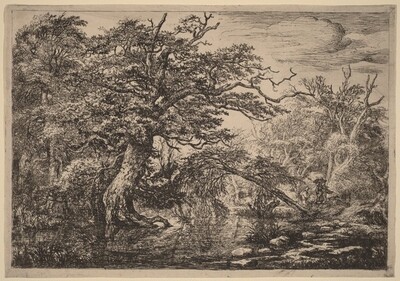
Dunes by the Sea (1648) is one of Ruisdael's earliest works, depicting the characteristic Dutch landscape of coastal dunes—the sandy ridges that protected the low-lying Netherlands from the North Sea and that defined the relationship between land and water in Dutch consciousness. The 1648 date places this during Ruisdael's teenage years—he was approximately twenty—and the painting demonstrates the precocious talent that would make him the greatest Dutch landscape painter. The dune landscape, with its sandy ridges, scattered vegetation, and the sea visible beyond, provided Ruisdael with a subject that was both specifically Dutch and universally significant: the boundary between land and sea was the geographical fact that shaped Dutch national identity, and the dunes that protected the land from the sea were the physical embodiment of the Dutch struggle to create and maintain their country. Ruisdael's early treatment of this subject already shows the dramatic power that would characterize his mature work: the dunes rise with a weight and mass that suggests geological forces rather than mere sand deposits, and the sea beyond carries the constant threat of inundation that was the Dutch landscape's deepest reality. The painting's atmosphere—the particular quality of coastal light that gives Dutch seascape its distinctive character—is rendered with the sensitivity that would mature into Ruisdael's most celebrated achievement.
Cultural Impact
Ruisdael's dune paintings influenced how the Dutch coastal landscape was represented in art, establishing the dunes as a significant artistic subject that was specifically Dutch. The paintings influenced later seascape painters who similarly found subjects at the boundary between land and water. The 1648 dune landscape influenced how Ruisdael's precocious development was understood, documenting the talent that would make him the greatest landscape painter of the Dutch Golden Age.
Why It Matters
This painting matters because it captures the Dutch landscape's defining feature—the dunes that protected the land from the sea—with the dramatic power that would make Ruisdael's landscape painting the most influential of the Dutch Golden Age. The dunes and the sea together represent the geographical reality that shaped Dutch national identity, and Ruisdael's early treatment of this subject already demonstrates the emotional intensity that his mature work would achieve.