Provenance
William D. Stuart, at least in 1857.[1] Mrs. P.A. Chamier; (sale, Christie, Manson & Woods, London, 10 April 1981, no. 74). Dr. F. Zoellner, Risch, Switzerland;[2] (sale, Sotheby's, London, 16 December 1999, no. 28); (Richard Green, London); private collection, United Kingdom; sold February 2018 through (Johnny Van Haeften, Ltd., London) to NGA.
[1] Stuart lent the painting to an 1857 exhibition at the British Institution.
[2] The 1999 Sotheby's sale catalogue describes the painting as "from the Estate of the late" Dr. Zoellner.
Accession Number
2018.10.1
Medium
oil on canvas
Dimensions
overall: 66.4 × 52.9 cm (26 1/8 × 20 13/16 in.)
Classification
Painting
Credit Line
The Lee and Juliet Folger Fund
Tags
Painting Baroque (1600–1750) Oil Painting Canvas Dutch
Background & Context
Background Story
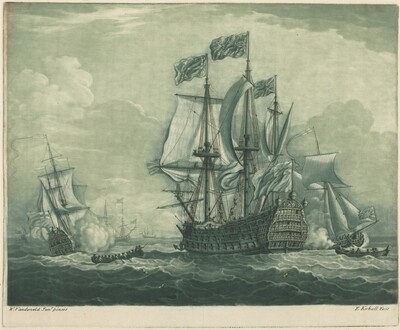
Willem van de Velde the Younger (1633-1707) was a Dutch painter known for the precisely observed marine paintings that make him one of the most important marine painters in the history of art. An English Warship Firing a Salute from 1673 depicts an English warship firing a salute in the precisely observed, atmospheric manner that distinguishes van de Velde the Younger's best work from the more general marine painting of his contemporaries. After moving from the Netherlands to England in 1672, van de Velde the Younger became the most important marine painter at the English court, and the 1673 painting shows his talent for depicting English warships with both precise observation and atmospheric effect.
Cultural Impact
An English Warship Firing a Salute is important in the history of marine painting because it demonstrates the precisely observed, atmospheric manner that van de Velde the Younger brought to marine subjects as one of the most important marine painters in the history of art. Van de Velde the Younger's precisely observed marine paintings—combining the precise observation of ships with the atmospheric effect of the sea and sky that is his most distinctive contribution—represent one of the most accomplished traditions in marine painting, and the 1673 painting shows this tradition at its most precisely observed and atmospheric.
Why It Matters
An English Warship Firing a Salute is van de Velde the Younger's precisely observed marine painting: an English warship rendered in the atmospheric manner of the most important marine painter in the history of art. The 1673 painting shows the combination of precise observation with atmospheric effect that makes van de Velde the Younger the most accomplished marine painter.