
Provenance
Ross Kepler, Maplewood, New Jersey; purchased 1994 by William H. [1929-2020] and Abigail Booth Gerdts, New York;[1] gift 2018 to NGA.
[1] Per documention from Abigail Booth Gerdts provided with the gift, in NGA curatorial files.
Accession Number
2018.44.26
Medium
oil on canvas
Dimensions
overall: 39.37 × 46.67 cm (15 1/2 × 18 3/8 in.) | framed: 52.71 × 59.69 × 8.26 cm (20 3/4 × 23 1/2 × 3 1/4 in.)
Classification
Painting
Credit Line
Gift of William and Abigail Gerdts
Tags
Painting Neoclassical & Romantic (1751–1850) Oil Painting Canvas American
Background & Context
Background Story
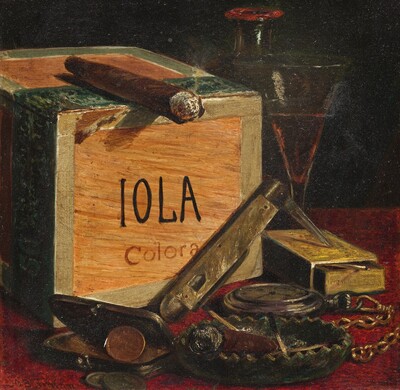
John O'Brien Inman's Still Life, dated 1868, is a work by a painter descended from one of America's most accomplished still life dynasties. John O'Brien Inman (1828-1894) was the son of Henry Inman, the distinguished portrait and genre painter who co-founded the National Academy of Design and served as its vice president. While his father achieved fame as a portraitist, the younger Inman gravitated toward still life painting, a genre that was experiencing a surge of popularity in mid-19th-century America. The year 1868 places this work in the post-Civil War period, when American still life painting was entering a phase of increasing sophistication and variety. The genre had evolved from the rigid conventions of the early Peale family still lifes into a more diverse field that embraced floral compositions, fruit pieces, game still lifes, and the tabletop arrangements called 'dessert' or 'breakfast' pieces. Inman's still life practice reflected both his family's artistic heritage and the broader currents of taste in American art during the Gilded Age. The elder Inman's connections to the National Academy and to the commercial art world of New York provided his son with both training opportunities and exhibition venues. The still life of 1868 likely displays the careful observation and polished technique that characterized successful still life painting of the era, when collectors prized works that combined decorative appeal with an illusionistic verisimilitude that demonstrated the painter's mastery over the challenges of depicting reflected light, varied textures, and natural forms in convincing recession.
Cultural Impact
The Inman family's artistic legacy bridges portraiture and still life in 19th-century American art. John O'Brien Inman's work demonstrates how still life painting, often considered a lesser genre, was in fact a field demanding exceptional technical skill that attracted painters from distinguished artistic families.
Why It Matters
This painting connects the Inman family's artistic dynasty to the flourishing of American still life, showing how genre traditions were transmitted and transformed across generations.
![Saint Bernard and Saint Catherine of Alexandria with the Virgin of the Annunciation [right panel]](https://api.nga.gov/iiif/e6890364-4d99-4684-a62b-5060ee3c3446/full/400,/0/default.jpg)