Provenance
Recorded as from Philadelphia.[1] (Walter Wallace, city unknown), by whom sold in 1956 to Edgar William and Bernice Chrysler Garbisch; gift to NGA, 1968.
[1] Although the standard Garbisch information sheet lists "Philadelphia" on the line "where found," other donor records state that the painting "originated from Oregon." According to Christine Peck, librarian, Aberdeen Timberland Library (letter of 24 July 1989, in NGA curatorial files), one Aberdeen [Washington state] resident who lived in a downtown hotel in the 1950s distinctly remembers the painting hanging there on the wall.
Accession Number
1968.26.3
Medium
oil on canvas
Dimensions
overall: 70.7 x 106.4 cm (27 13/16 x 41 7/8 in.) | framed: 84.4 x 120 x 6.3 cm (33 1/4 x 47 1/4 x 2 1/2 in.)
Classification
Painting
Credit Line
Gift of Edgar William and Bernice Chrysler Garbisch
Tags
Painting Early Modern (1901–1950) Oil Painting Canvas American
Background & Context
Background Story
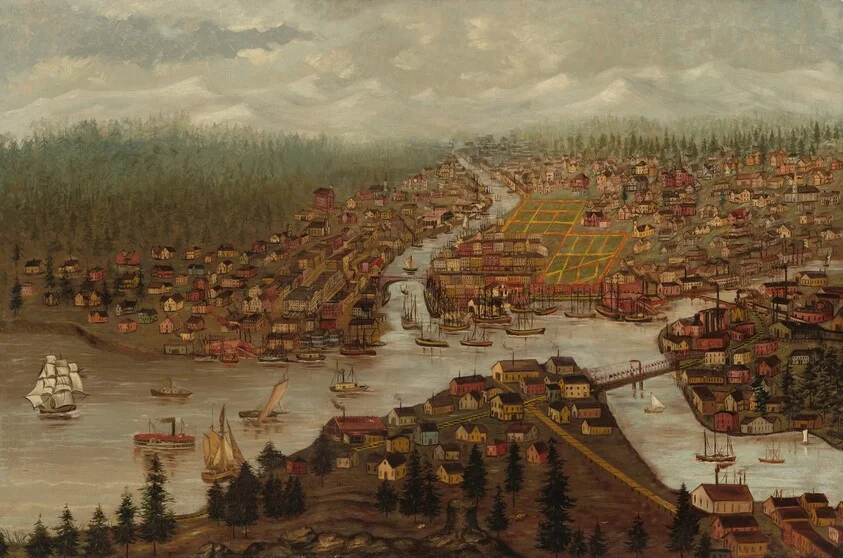
"View of Aberdeen, Washington" is an early twentieth-century American painting depicting the small city of Aberdeen, located at the confluence of the Chehalis and Wishkah rivers in Grays Harbor County, Washington. The painting captures Aberdeen during its most prosperous period, when the city was one of the largest lumber and shipbuilding centers on the Pacific Coast — a rough, energetic port town where the forest industry transformed the landscape and fueled a booming local economy.
Founded in 1884 and incorporated in 1890, Aberdeen grew rapidly at the turn of the twentieth century as the old-growth forests of the Olympic Peninsula were logged and the timber was shipped from Grays Harbor to markets around the world. The city's motto, perched on a hillside overlooking the harbor, was "Come Visit and Stay Awhile" — a slogan that belied the rough, often dangerous reality of life in a logging town where industrial accidents, bar fights, and floods were routine. The painter Kurt Cobain, born in Aberdeen in 1967, later described it as a "small, depressed logging town" — a far cry from the bustling port depicted in this painting.
The painting belongs to a genre of American city views that flourished in the late nineteenth and early twentieth centuries, when the rapid growth of towns and cities across the American West created a market for commemorative views that documented civic pride and economic progress. These paintings served as both visual records of urban development and advertisements for prospective residents and investors, emphasizing the orderly streets, handsome buildings, and busy waterfronts that signified a community on the rise.
The choice of Aberdeen as a subject reflects the optimism of the early twentieth century, when the Pacific Northwest was being transformed from frontier wilderness into productive industrial landscape. The painting's relatively conventional style — detailed, topographical, and somewhat idealized — is characteristic of the civic view genre, which valued legibility and completeness over artistic innovation. What gives the painting its historical value is its documentary content: it preserves a visual record of a specific place at a specific moment in its history, capturing the buildings, waterfront, and topography of a town that would change dramatically over the following century as the timber industry declined and Aberdeen entered a long period of economic stagnation.
Cultural Impact
Civic views like this painting documented the rapid growth of Pacific Northwest communities during the timber boom, creating visual records of towns that would be transformed by the decline of the logging industry in later decades.
Why It Matters
This painting preserves a view of Aberdeen, Washington during its timber-industry boom — a visual document of Pacific Northwest economic optimism at the turn of the twentieth century.