
Provenance
The artist, Paris; by inheritance to her husband, Jean-Pierre-Silvestre Coster [1745-1824]; their estate sale, at his residence, 47 boulevard du Temple, Paris, 21 June 1824, no. 1;[1] purchased by a member of the Coster family and then probably by descent to Coster heirs. Acquired in the second half of the 1940s by a private collector in Grand Est region, France; by inheritance to his son and daughter, France; (sale, Christie's, Paris, 15 June 2023, no. 42); purchased by NGA.
[1] _Notice des tableaux de fleurs peints par Mme Vallayer-Coster, Ancien member de l’Académie royale de Peinture_, introduction by Charles Paillet, Paris: 1824. The painting sold for 1,100 francs. The sale catalogue described the painting thus: “Un des ouvrages les plus capitaux de cette célèbre artiste, il offre, pour objet principal, un vase d'albâtre richement orné, dans lequel sont placées des fleurs du plus bel éclat et du plus beau choix. Ce vase, posé sur une table à dessus de marbre blanc, est entouré de fruits, tels que grapes de raisin, pêches et ananas. Il porte la date de 1783 ; et, depuis cette époque, qui était celle de la grande force des talens [sic] de Mme Coster, elle a constamment résisté aux instances réitérées des personnages illustres et des amateurs distingués qui désiraient posséder ce tableau, dont elle n'a jamais voulu se désaisir, le regardant comme le meilleur de ses ouvrages.” (“One of the most significant works by this famous artist, it presents as its main subject a richly adorned alabaster vase, in which flowers of the most brilliant splendor and finest selection are placed. This vase, placed on a white marble tabletop, is surrounded by fruits such as grapes, peaches, and pineapples. It bears the date of 1783, and since that time, which was the period of Madame Coster's great talent, she has consistently resisted the repeated requests of illustrious individuals and distinguished art lovers who desired to possess this painting, as she never wanted to part with it, considering it the best of her works.”)
Accession Number
2023.40.1
Medium
oil on canvas
Dimensions
overall: 108.5 × 89.5 cm (42 11/16 × 35 1/4 in.)
Classification
Painting
Credit Line
Chester Dale Fund
Tags
Painting Neoclassical & Romantic (1751–1850) Oil Painting Canvas French Color: Brown
Background & Context
Background Story
Anne Vallayer-Coster's "Still Life with Flowers in an Alabaster Vase and Fruit" (1783) is a masterwork by one of the most accomplished still-life painters of eighteenth-century France. The painting presents an opulent arrangement of flowers — roses, peonies, and other blooms spilling from an alabaster vase — accompanied by a selection of fruit arranged on a marble ledge. Every petal, every droplet of water on the fruit's skin, every reflection in the polished stone surfaces is rendered with the meticulous precision that earned Vallayer-Coster the admiration of her contemporaries and the rare honor of admission to the Royal Academy.
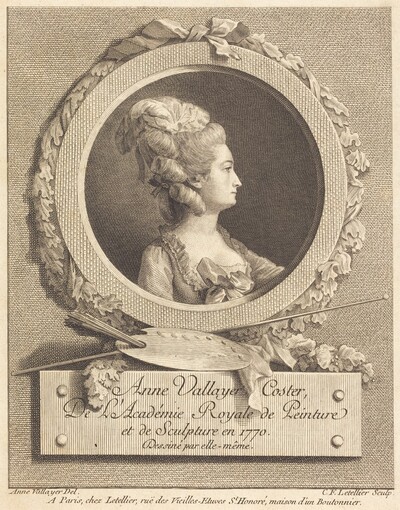
Vallayer-Coster (1744–1818) achieved what was nearly impossible for a woman artist in ancien régime France: she was received into the Académie Royale de Peinture et de Sculpture in 1770, at the age of 26, on the strength of still lifes that displayed such virtuosity that even the famously critical Denis Diderot praised her, writing: "The attributes of painting are the same as those of music: truth, nobility, and grace. Mademoiselle Vallayer's work has all three." Her reception piece — a pair of still lifes depicting attributes of the arts and attributes of music — demonstrated her command of the entire range of still-life subgenres.
The 1783 painting represents Vallayer-Coster's mature style, in which her technical precision is combined with a new compositional sophistication. The alabaster vase — a luxury object that signals the wealth and refinement of the painting's intended audience — anchors the composition, while the cascading flowers create a dynamic diagonal movement that prevents the arrangement from appearing static. The fruit, arranged on the ledge below, provides a coloristic counterpoint to the flowers, their warm tones contrasting with the cool whites and greens of the floral arrangement.
The painting also carries an undercurrent of vanitas — the still-life tradition's memento mori. The flowers are at the peak of their bloom, which means they are on the verge of wilting; the fruit is perfectly ripe, which means it is on the verge of decay. Vallayer-Coster's meticulous observation of these moments of peak beauty serves as a reminder that all earthly splendor is transient. This philosophical dimension, combined with her extraordinary technical skill, elevated Vallayer-Coster's work above mere decorative display and placed it firmly within the intellectual tradition of French still-life painting that stretched from Chardin to the present day.
Cultural Impact
Vallayer-Coster's admission to the Royal Academy in 1770 made her one of very few women to achieve this honor in the eighteenth century, and her still lifes established a standard of excellence that influenced the genre throughout France.
Why It Matters
This painting demonstrates the extraordinary technical skill and compositional intelligence that made Vallayer-Coster one of the few women admitted to the French Royal Academy — a still life where beauty and vanitas coexist in perfect balance.


![Saint Bernard and Saint Catherine of Alexandria with the Virgin of the Annunciation [right panel]](https://api.nga.gov/iiif/e6890364-4d99-4684-a62b-5060ee3c3446/full/400,/0/default.jpg)