Provenance
(Paul Pétridès, Paris);[1] sold to Captain Edward H. Molyneux [1891-1974], Paris, by 1952; sold 15 August 1955 to Ailsa Mellon Bruce [1901-1969], New York, as _Landscape with Houses_;[2] bequest 1970 to NGA.
[1] Letter of 6 December 1977 from Paul Pétridès, in NGA curatorial files.
[2] Purchase date of Molyneux collection according to the Ailsa Mellon Bruce notebook now in NGA archives.
Accession Number
1970.17.87
Medium
oil on cardboard on wood
Dimensions
overall: 25.1 x 34.5 cm (9 7/8 x 13 9/16 in.) | framed: 48.3 x 59.1 x 6.4 cm (19 x 23 1/4 x 2 1/2 in.)
Classification
Painting
Credit Line
Ailsa Mellon Bruce Collection
Tags
Painting Early Modern (1901–1950) Oil Painting Board French
Background & Context
Background Story
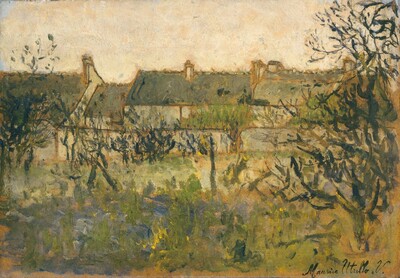
Landscape, Pierrefitte (c. 1907) is one of Utrillo's earliest mature works, depicting the suburb of Pierrefitte north of Paris. The painting belongs to Utrillo's pre-white period—a phase sometimes called his 'Impressionist period' when his palette was darker and more muted. Pierrefitte, then a developing suburb at the edge of Paris's urban expansion, provided a landscape at the boundary between city and country: half-built streets, open fields, and the transitional architecture of a community in formation. The year 1907 is significant: Utrillo was 24, had recently begun painting seriously under his mother Suzanne Valadon's encouragement, and was developing the obsessive dedication to street and landscape painting that would define his career. The painting's relative darkness—compared to the brilliant whites of his later period—reflects the influence of the Post-Impressionist approaches current in Montmartre, including the work of his mother and her circle. The painting also documents a phase of Paris's suburban development—the expansion of the ville into the banlieue—that would transform the Île-de-France over the following century.
Cultural Impact
Utrillo's early suburban paintings influenced how the edge of Paris was represented in art, documenting a phase of suburban development that would intensify dramatically in the 20th century. The paintings influenced French landscape painting's engagement with suburban subjects—a tradition that would extend through Dubuffet's suburban landscapes to contemporary photographers documenting the banlieue. The early works also provided art historians with crucial documentation of Utrillo's artistic development.
Why It Matters
This painting matters because it captures a transitional landscape—the edge of Paris in 1907—that no longer exists in the form Utrillo recorded. The painting documents a phase of urban expansion, capturing the moment when rural landscape and suburban development coexisted. For contemporary audiences familiar with Paris's fully developed suburbs, the painting provides a glimpse of the banlieue before it became what it is today.