Provenance
(Alex Reid, Glasgow) and (L.H. Lèfevre & Son, London); sold c. 1924 to Mrs. R. A. Workman, London;[1] (her sale, at her house by Curtis & Henson, London, 21 December 1931, no. 765). Marcel Fleischmann, Zurich, in 1939.[2] Acquired between 1952 and 1955 by Capt. Edward H. Molyneux [1891-1974], Paris;[3] sold 15 August 1955 to Mrs. Ailsa Mellon Bruce [1901-1969], New York; bequest 1970 to NGA.
[1]See letter from Alex Reid & Lèfevre dated 9 December 1977 in NGA curatorial files.
[2]Lent by Fleischmann to 1939 exhibition at the Museum of Modern Art.
[3]See letter from Molyneux to Bruce, dated 30 July 1955, in NGA Gallery Archives RG39, copy in NGA curatorial records.
Accession Number
1970.17.88
Medium
oil on cardboard
Dimensions
overall: 45.7 x 33.6 cm (18 x 13 1/4 in.) | framed: 66 x 67 x 7.6 cm (26 x 26 3/8 x 3 in.)
Classification
Painting
Credit Line
Ailsa Mellon Bruce Collection
Tags
Painting Early Modern (1901–1950) Oil Painting Board French
Background & Context
Background Story
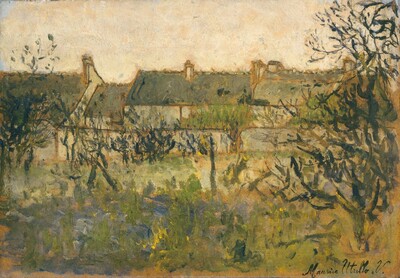
Rue Cortot, Montmartre (1909) depicts the narrow street in Montmartre where Suzanne Valadon had her studio and where the Musée de Montmartre is now located. The Rue Cortot, one of the oldest streets in Montmartre, was a place of deep personal significance for Utrillo: it was where his mother lived and worked, where he spent formative years surrounded by artists, and where his artistic identity was shaped. The painting captures the street's steep, cobblestoned character with the white-washed walls that defined Utrillo's mature style. The year 1909 places this among the first works of Utrillo's celebrated white period—the technique of mixing sand and plaster into white paint that created his most distinctive surfaces. The painting likely emphasizes the street's architectural walls—their textures, their colors (predominantly white and cream), and their geometries—while the cobblestones provide rhythmic patterns and any figures provide scale and human presence. Montmartre, still partly rural in 1909 with its vineyards and windmills alongside artists' studios and cabarets, was being transformed by urban development. Utrillo's painting documents the Montmartre that was disappearing—the old village within the city that had sheltered artists from Renoir to Picasso and that Utrillo recorded with the urgency of a person preserving a vanishing world.
Cultural Impact
Utrillo's Montmartre paintings are among the most influential 20th-century representations of Paris, defining how the district is visually imagined. His paintings influenced tourism imagery, film set design, and the cultural perception of Montmartre as a village of white walls and cobblestones—an image that persists despite the neighborhood's transformation. The Rue Cortot painting specifically influenced the preservation of the Musée de Montmartre and the cultural recognition of Montmartre's artistic heritage.
Why It Matters
This painting matters because it represents the most authentic visual record of a Montmartre that no longer exists in the form Utrillo painted. The white walls, cobblestone streets, and village atmosphere that defined old Montmartre have been largely replaced by tourism infrastructure, yet Utrillo's image persists in the cultural imagination as the genuine article. The painting demonstrates that art can preserve not just the appearance of a place but its character.