Provenance
(Carroll Carstairs Gallery, New York); sold 26 January 1949 to Mrs. Ailsa Mellon Bruce [1901-1969], New York;[1] bequest 1970 to NGA.
[1] Carstairs invoice dated 26 January 1949, copy in NGA curatorial files.
Accession Number
1970.17.89
Medium
oil on canvas
Dimensions
overall: 60.8 x 80.7 cm (23 15/16 x 31 3/4 in.) | framed: 76.5 x 97.1 x 5.7 cm (30 1/8 x 38 1/4 x 2 1/4 in.)
Classification
Painting
Credit Line
Ailsa Mellon Bruce Collection
Tags
Painting Early Modern (1901–1950) Oil Painting Canvas French
Background & Context
Background Story
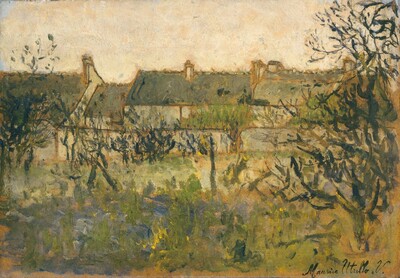
Street at Corté, Corsica (1913) represents a significant departure from Utrillo's Parisian subjects, depicting the mountain town of Corté in the rugged interior of Corsica. Corté, the historical capital of Corsica and a stronghold of Corsican independence under Pasquale Paoli, provided Utrillo with architecture and landscape dramatically different from his usual Montmartre streets. The town's stone buildings, dramatically sited on a mountainside against a background of wild Corsican terrain, offered walls and streets that must have appealed to Utrillo's architectural sensibility while presenting new chromatic challenges. The year 1913 places this painting within Utrillo's most productive period, when he was painting with obsessive energy despite his mental health difficulties. A trip to Corsica—possibly motivated by health or by a desire for new subjects—provided visual material that contrasts with his Parisian oeuvre. Corsica's Mediterranean light—stronger and more dramatic than Paris's—required adjustments to his characteristic white-on-white technique, resulting in stronger contrasts and more emphatic shadow. The painting also connects to the broader French artistic engagement with Corsica, which represented France's exotic wild frontier—a Mediterranean island with a culture distinct from the mainland.
Cultural Impact
Utrillo's Corsican paintings influenced how the island's architecture and landscape were represented in French art, contributing to the cultural perception of Corsica as a rugged, authentic Mediterranean landscape distinct from mainland France. The paintings influenced tourism imagery for Corsica and the cultural recognition of Corté as a town of historical and visual significance. The works also demonstrated Utrillo's ability to translate his vision to non-Parisian subjects.
Why It Matters
This painting matters because it demonstrates that Utrillo's artistic vision—his obsessive attention to architectural walls and streets—was not merely a habit formed by living in Montmartre but a way of seeing that could serve any architectural subject. The walls of Corté receive the same dedicated treatment as the walls of the Rue Cortot, suggesting that Utrillo's art was rooted in perception rather than place.