Provenance
Probably Leopold III Friedrich Franz, Duke of Anhalt-Dessau [1740-1817], Gotisches Haus, Wörlitz, near Dessau;[1] probably by inheritance to his grandson, Leopold IV Friedrich, Duke of Anhalt [1794-1871], Gotisches Haus; by inheritance to his son, Friedrich I, Duke of Anhalt [1831-1904], Gotisches Haus; by inheritance to his son, Friedrich II, Duke of Anhalt [1856-1918], Gotisches Haus; by inheritance to his son, Eduard Georg Wilhelm, Duke of Anhalt [1861-1918], Gotisches Haus; by inheritance to his son, Joachim Ernst, Duke of Anhalt [1901-1947], Gotisches Haus; sold early 1927 to (Hugo Perls, Berlin);[2] sold via the Mannheimer collection, Amsterdam, to (Duveen Brothers, Inc., London, New York, and Paris);[3] purchased November 1927 by Andrew W. Mellon, Pittsburgh and Washington, D.C.; deeded 5 June 1931 to The A.W. Mellon Educational and Charitable Trust, Pittsburgh; gift 1937 to NGA.
[1] This prince built the Gotisches Haus and its English park and was an active collector, adding early German and Netherlandish paintings to the family holdings; see C. Rost, "Der alte Nassau-Oranische Bilderschatz und sein späterer Verbleib," _Jahrbücher für Kunstwissenschaft_ 6 (1873), 52-93, esp. 78-79, listing early catalogues of the collection. The descriptions in the early catalogues of the Anhalt-Dessau collection are not sufficiently specific to identify the _Madonna and Child with Angels_.
[2] According to a note on a photograph in the Friedländer archive, Rijksbureau voor Kunsthistorische Documentatie, (RKD), The Hague; and a letter of 23 October 1961 from Hugo Perls to the NGA (in NGA curatorial files).
[3] Duveen Brothers Records, accession number 960015, Research Library, Getty Research Institute, Los Angeles: reel 120, box 265, folder 18; and transcriptions from the Duveen Brothers Records (copies and transcriptions in NGA curatorial files).
Accession Number
1937.1.41
Medium
oil on panel
Dimensions
painted surface: 57.6 × 46.4 cm (22 11/16 × 18 1/4 in.) | overall (panel): 58.8 × 48 cm (23 1/8 × 18 7/8 in.) | framed: 69.22 × 57.47 × 9.53 cm (27 1/4 × 22 5/8 × 3 3/4 in.)
Classification
Painting
Credit Line
Andrew W. Mellon Collection
Tags
Painting Renaissance (1400–1599) Oil Painting Panel Painting Netherlandish
Background & Context
Background Story
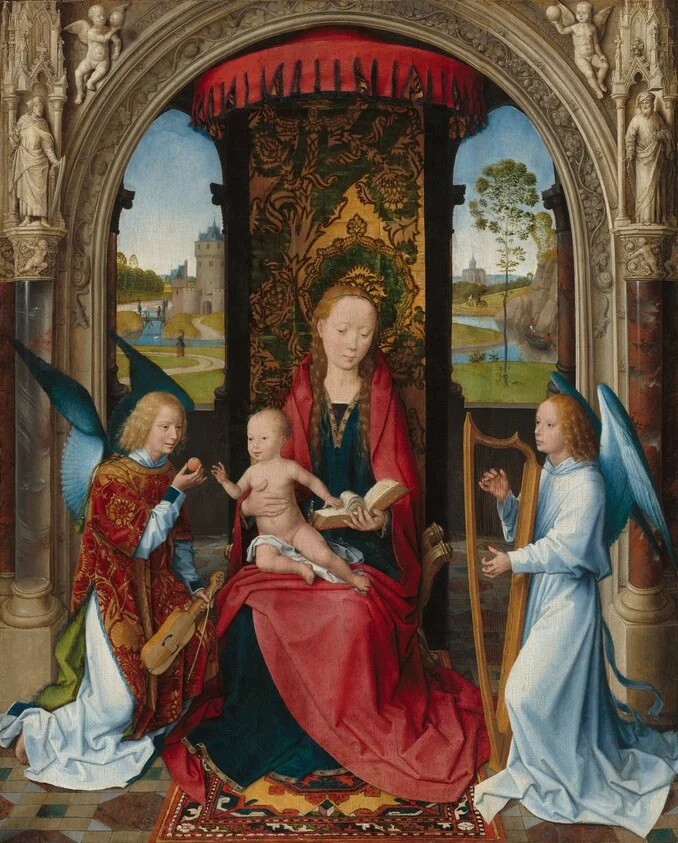
Hans Memling (c. 1430-1494) was a Netherlandish painter known for the harmonious, devotional manner that combines the Netherlandish tradition of Jan van Eyck and Rogier van der Weyden with a softer, more lyrical quality that distinguishes his best work. Madonna and Child with Angels from after 1479 depicts the Virgin and Child attended by angels in the harmonious, devotional manner that makes Memling the most accomplished Netherlandish painter of the late 15th century. The after 1479 date places this in Memling's mature period, when he was producing the devotional paintings that are his most accomplished works.
Cultural Impact
Madonna and Child with Angels is important in the history of Netherlandish painting because it demonstrates the harmonious, devotional manner that Memling developed from the traditions of van Eyck and Rogier van der Weyden. Memling's softer, more lyrical quality—compared to the more austere Rogier tradition—created a type of devotional painting that was immensely popular throughout Europe in the late 15th century, and his paintings were among the most exported from the Netherlands to the rest of Europe.
Why It Matters
Madonna and Child with Angels is Memling's harmonious devotion at its most accomplished: the Virgin and Child attended by angels rendered in the softer, more lyrical manner that distinguishes his work from the more austere Rogier tradition. The after 1479 painting is the most accomplished Netherlandish devotional painting of the late 15th century.
![Saint Veronica [obverse]](https://api.nga.gov/iiif/8788f9a6-142d-40b7-953b-a9a208ff2eef/full/400,/0/default.jpg)
![Chalice of Saint John the Evangelist [reverse]](https://api.nga.gov/iiif/1a761edd-c52e-47c0-b422-df074e14c803/full/400,/0/default.jpg)