Provenance
Almost certainly Herman Becker [c. 1617-1678], Amsterdam.[1] Pierre Crozat [1665-1740], Paris, before 1740; by inheritance to his nephews, first to Louis-François Crozat, marquis du Châtel [1691-1750], Paris, and then [on Louis-François' death without a male heir] to Louis-Antoine Crozat, baron de Thiers [1699-1770], Paris; the latter's heirs; purchased 1772, through Denis Diderot [1713-1784] as an intermediary, by Catherine II, empress of Russia [1729-1796], for the Imperial Hermitage Gallery, Saint Petersburg; sold February 1931, as a painting by Rembrandt, through (Matthiesen Gallery, Berlin; P. & D. Colnaghi & Co., London; and M. Knoedler & Co., New York) to Andrew W. Mellon, Pittsburgh and Washington, D.C.; deeded 1 May 1937 to The A.W. Mellon Educational and Charitable Trust, Pittsburgh; gift 1937 to NGA.
[1] For Becker's collection, see Hugo J. Postma, "De Amsterdamse verzamelaar Herman Becker (c. 1617-1678) Nieuwe gegevens over een geldschieter van Rembrandt," _Oud-Holland_ 102 (1988): 1-21. The painting appears in the 1678 inventory (fol. 285r as "Een vrouwtje aende put van Rembrandt van Rijn").
Accession Number
1937.1.74
Medium
oil on canvas
Dimensions
overall: 107.3 × 91.4 cm (42 1/4 × 36 in.) | framed: 135.26 × 120.65 × 7.62 cm (53 1/4 × 47 1/2 × 3 in.)
Classification
Painting
Credit Line
Andrew W. Mellon Collection
Tags
Painting Baroque (1600–1750) Oil Painting Canvas Dutch
Background & Context
Background Story
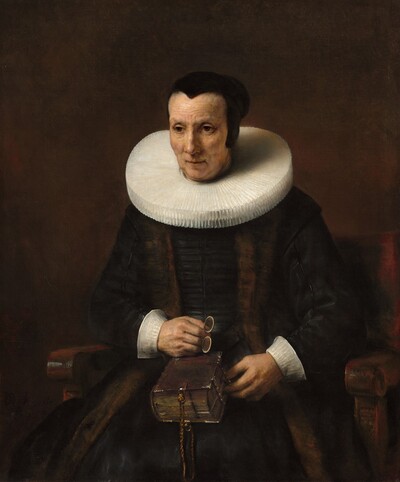
A Girl with a Broom (c. 1648-1650) depicts a young girl engaged in domestic work—the sweeping that was one of the most basic and universal forms of household labor. The painting belongs to Rembrandt's genre subjects: scenes of ordinary life that he treated with the same psychological and formal attention that he brought to his more prestigious commissions. The 1648-50 date places this during Rembrandt's most productive and technically accomplished period, when his handling had reached the expressive freedom that distinguishes his mature work. The girl, rendered with the psychological attention that Rembrandt brought to all his figure subjects, is not merely a genre type but an individual whose concentration on her work reveals character. The broom, the simplest of household implements, becomes in Rembrandt's handling an instrument that gives the girl purpose and presence—the tool that connects her to the domestic work that defined women's experience in 17th-century Dutch society. The painting also reflects the Dutch Golden Age's unprecedented attention to domestic life: the genre painters who depicted ordinary households performed the same cultural function as the still-life painters who depicted ordinary objects—they argued that daily experience deserved the same artistic attention that history painting traditionally received.
Cultural Impact
Rembrandt's genre paintings influenced how domestic work was represented in Dutch Golden Age art, arguing that ordinary labor deserved the same attention as prestigious subjects. The paintings influenced later Dutch genre painters who similarly found artistic significance in domestic life. A Girl with a Broom influenced how women's domestic work was visually represented, connecting household labor to human dignity.
Why It Matters
This painting matters because it demonstrates that Rembrandt's psychological and formal attention could serve the most ordinary subjects as effectively as it served his most prestigious commissions—the girl with her broom is rendered with the same chiaroscuro modeling and character insight that his portraits of wealthy patrons received, arguing that domestic work deserves the artistic attention that history painting traditionally claimed.