Provenance
Possibly Harman van Swol; possibly (his sale, Jan Pietersz. Zomer, Amsterdam, 20 April 1707, no. 15).[1] Acquired 1765 in Rotterdam by (Philippus Florentinus Vergeloo, Antwerp) for Count Johan Carl Philipp Cobenzl [1712-1770]; sold 1768 to Catherine II, empress of Russia [1729-1796], Saint Petersburg;[2] Imperial Hermitage Gallery, Saint Petersburg; sold February 1931 through (Matthiesen Gallery, Berlin; P. & D. Colnaghi & Co., London; and M. Knoedler & Co., New York) to Andrew W. Mellon, Pittsburgh and Washington; deeded 30 March 1932 to The A. W. Mellon Educational and Charitable Trust, Pittsburgh; gift 1937 to NGA.
[1] In the 1707 sale in Amsterdam, a painting described as "Een Ambassadeur van Moscovien, van Rembrandt kragtig geschildert" (An Ambassador of Moscow, powerfully depicted by Rembrandt) may have been this work; the association of this painting with _A Polish Nobleman_ was first made in Stichting Foundation Rembrandt Research Project, _A Corpus of Rembrandt Paintings_, vol. 3, _1635–1642_, ed. Josua Bruyn et al., Dordrecht, Boston, and London, 1989: 247.
[2] On the identification of Cobenzl as the collector who sold the painting to Catherine II, and of Vergeloo as his source, see Catherine Phillips, "The Provenance of Rembrandt's 'Polish Nobleman' (1637) in the National Gallery of Art, Washington," _The Burlington Magazine_ 151 (February 2009): 84-85. When _A Polish Nobleman_ was first described in the catalogue of Catherine II's collection, compiled between 1773 and 1785, it bore the title "Portrait d'un Turc."
Accession Number
1937.1.78
Medium
oil on panel
Dimensions
overall: 96.8 x 66 cm (38 1/8 x 26 in.)
Classification
Painting
Credit Line
Andrew W. Mellon Collection
Tags
Painting Baroque (1600–1750) Oil Painting Panel Painting Dutch
Background & Context
Background Story
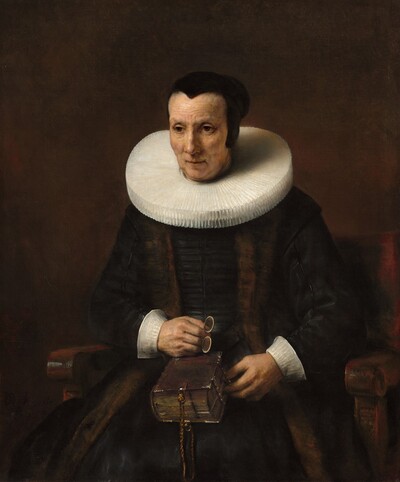
A Polish Nobleman, painted in 1637, depicts a richly dressed man wearing a fur-trimmed cap, a heavy gold chain, and an ornate sword - attributes that identify him as a member of the Polish-Lithuanian nobility, the szlachta. The identity of the sitter has never been conclusively established; he may be a Polish diplomat visiting Amsterdam, or a figure from Rembrandt's imagination dressed in exotic costume.
Rembrandt produced a remarkable series of tronies - character heads and costume studies - throughout the 1630s. These works were not formal portraits but explorations of human physiognomy, costume, and expression. A Polish Nobleman belongs to this tradition: the sitter's elaborate costume, his commanding gaze, and his slightly fierce expression suggest a study of power, wealth, and foreignness rather than a commission from a specific patron.
The painting exemplifies Rembrandt's masterful handling of light and texture. The fur cap, the gold chain, the aged skin of the face - each surface is rendered with a different technique, creating a tactile richness that makes the viewer feel they could reach out and touch the materials. The dark background, from which the figure emerges, concentrates attention on the face and its inscrutable expression.
Cultural Impact
Rembrandt's tronies established the artist's right to paint from imagination as well as from life. By creating fictional characters of compelling psychological presence, he demonstrated that portraiture could transcend mere likeness to become a form of humanist philosophy - an inquiry into the nature of power, identity, and the self.
Why It Matters
A Polish Nobleman records Rembrandt at the height of his technical powers and social confidence. It is both a portrait of a specific type - the powerful Eastern European noble - and a meditation on the relationship between costume, identity, and the painter's imagination.