Provenance
Sir John Charles Frederic Sigismund Day [d. 1908], Falkland Lodge, Newbury, Berkshire, by 1891;[1] (his estate sale, Christie, Manson & Woods, Ltd., London, 13 May 1909, no. 11); purchased by (Arnold & Tripp, Paris).[2] (E.J. van Wisselingh and Co., Amsterdam); sold 1909 to (M. Knoedler & Co., London, New York, and Paris);[3] sold 1909 to R. Horace Gallatin [1871-1948], New York; bequest 1949 to NGA.
[1] Alfred Robaut, _L'oeuvre de Corot_, Paris, 1905: III:364, no. 2327 (1865-1872).
[2] Annotated catalogue of Day sale in M. Knoedler library.
[3] According to the Getty Provenance Index, quoting M. Knoedler records.
Accession Number
1949.1.2
Medium
oil on wood
Dimensions
overall: 32.2 x 40.6 x 1 cm (12 11/16 x 16 x 3/8 in.) | framed: 61 x 69.9 x 7.6 cm (24 x 27 1/2 x 3 in.)
Classification
Painting
Credit Line
Gift of R. Horace Gallatin
Tags
Painting Impressionist & Modern (1851–1900) Oil Painting French
Background & Context
Background Story
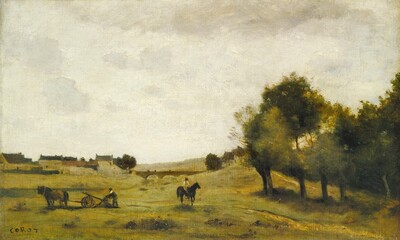
River View (1868/1872) represents Corot's mature landscape style applied to one of his most characteristic subjects—the French river landscape. Corot painted rivers throughout his career: the Tiber in Italy, the Loing at his home in Ville-d'Avray, and the numerous French waterways he visited during his annual painting tours. The 1868-72 date places this during Corot's late period, when his river landscapes had achieved the silvery tonal unity and atmospheric depth that made him the most influential landscape painter in France. Corot's treatment of the river combines reflective water, overhanging trees, and the particular quality of light that filtered through riverside foliage—elements that his characteristic brush technique (building foliage from small, individually painted masses) rendered with unprecedented atmospheric sensitivity. The small figures that typically animate Corot's river views—fishermen, washerwomen, or strolling couples—provide the human scale that gives the landscape its intimacy. The painting's river subject, with its slow-moving water and reflective surface, provided Corot with the luminous depth that was his greatest technical achievement—the quality that younger painters called, with admiration, la patte Corot.
Cultural Impact
Corot's river landscapes influenced how reflective water surfaces were represented in 19th-century painting, establishing approaches that the Impressionists would adapt to their own purposes. The paintings influenced later French landscape painters from Daubigny to Monet, all of whom acknowledged Corot's influence on their river subjects. The river view influenced how the French landscape tradition was understood, connecting 17th-century Dutch precedent to 19th-century French practice.
Why It Matters
This painting matters because it represents Corot's most characteristic subject—the French river landscape—at the height of his mature style, when atmospheric sensitivity and silvery tonal unity achieved the synthesis that influenced an entire generation of painters. Without Corot's river views, the Impressionist river subjects that followed would have lacked the artistic precedent that made their innovations possible.