Provenance
(Theodore Bonjean, Paris); sold 1890 to (Boussod Valadon et Cie., Paris); resold 1890 to (Theodore Bonjean, Paris).[1] Monsieur Bruneau, Paris, by 1895.[2] Ferdinand Blumenthal [d. 1914], Paris; his son Count Cecil Pecci-Blunt [d. 1965], Paris and New York;[3] gift 1955 to NGA.
[1] According to Boussod Valadon stockbooks (Dieterle collection, Series II, Box 12, p. 154, Getty Center Library, copies in NGA curatorial files). See also Alfred Robaut, _L'oeuvre de Corot_, Paris, 1905: III:88, no. 1505.
[2] Lent by Bruneau to _Exposition de centenaire de Corot_, Palais Galliéra, Paris, 1895, no. 23.
[3] Pecci-Blunt had the painting on consignment with Jacques Seligmann in 1941 but decided not to sell his collection at that time. Receipt for the return of the paintings to Pecci-Blunt dated November 19, 1941, Jacques Seligmann Papers, Archives of American Art, Box 75, folder 30. Lent by Pecci-Blunt through Seligmann to _The Functions of Color in Painting_, Phillips Memorial Gallery, Washington, 1941. See Correspondence between Seligmann and Phillips in Jacques Seligmann Papers, Archives of American Art, Box 130, folder 5 (copies NGA curatorial files).
Accession Number
1955.9.1
Medium
oil on canvas
Dimensions
overall: 49.3 x 65.5 cm (19 7/16 x 25 13/16 in.) | framed: 81.3 x 97.5 x 11.6 cm (32 x 38 3/8 x 4 9/16 in.)
Classification
Painting
Credit Line
Gift of Count Cecil Pecci-Blunt
Tags
Painting Impressionist & Modern (1851–1900) Oil Painting Canvas French
Background & Context
Background Story
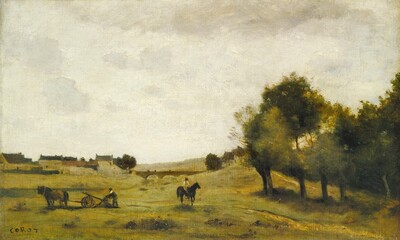
Ville-d'Avray (c. 1865) depicts the small town west of Paris where Corot lived and worked for most of his adult life—the landscape that was his most intimate and most frequently painted subject. Ville-d'Avray, with its ponds, its trees, and the particular quality of Île-de-France light that Corot captured more sensitively than any other painter, provided the setting for some of the most important landscape paintings of the 19th century. The 1865 date places this during Corot's late period, when his Ville-d'Avray subjects had achieved the poetic synthesis of observation and memory that made them the most admired works in his oeuvre. The town's ponds—created by Corot's father for a water supply system—provided the reflective surfaces that made Corot's most characteristic compositions possible: water reflecting trees, sky, and the soft light of the Île-de-France created the luminous depth that was his signature achievement. Corot's treatment of his home landscape, with the affection and familiarity that decades of daily observation had produced, gives these paintings their distinctive warmth—the quality that distinguishes works made at home from works made on traveling tours. Ville-d'Avray was Corot's equivalent of Monet's Giverny: the home landscape where artistic method and personal feeling converged to produce the works that defined his contribution to art.
Cultural Impact
Corot's Ville-d'Avray paintings influenced how home landscapes were represented in French art, establishing the tradition of the artist's residence as a primary subject that continued through Monet's Giverny to Bonnard's Le Bosquet. The paintings influenced virtually every landscape painter who followed, from the Barbizon group to the Impressionists. The Ville-d'Avray subject influenced how the Île-de-France landscape was perceived, connecting the region's quiet beauty to the artistic tradition that had revealed it.
Why It Matters
This painting matters because it represents the home landscape that was the foundation of Corot's art—the ponds, trees, and light of Ville-d'Avray that he painted with the familiarity and affection that only a lifetime of daily observation could produce. Without these home landscapes, Corot's influence on the Impressionists would have been very different, and the tradition of the artist's home as primary subject would have lacked its most important precedent.