Provenance
Acquired 1907 by (Ambroise Vollard [1866-1939], Paris);[1] sold to Marius de Zayas [1881-1961].[2] Purchased by Edward Steichen [1879-1973] for Eugene [1875-1959] and Agnes Ernst Meyer [1887-1970], Mount Kisco, New York, and Washington, D.C., by 1921;[3] gift 1958 to NGA.
[1] On Vollard acquisition, see John Rewald, _The Paintings of Paul Cézanne: A Catalogue Raisonné_, New York, 1996, no. 937.
[2] According to _Cezanne_, exh. cat., Grand Palais, Paris; Tate Gallery, London; Philadelphia Museum of Art, 1995, no. 189.
[3] Regarding Steichen's role, see letter dated 12 July 1977 from Katherine Graham in NGA curatorial files. Lent by the Meyers to the 1921 _Loan Exhibition of Impressionist and Post-Impressionist Paintings_ at the Metropolitan Museum of Art.
Accession Number
1958.10.1
Medium
oil on canvas
Dimensions
overall: 73.7 x 96.6 cm (29 x 38 1/16 in.) | framed: 97.8 x 120.3 x 5.7 cm (38 1/2 x 47 3/8 x 2 1/4 in.)
Classification
Painting
Credit Line
Gift of Eugene and Agnes E. Meyer
Tags
Painting Impressionist & Modern (1851–1900) Oil Painting Canvas French
Background & Context
Background Story
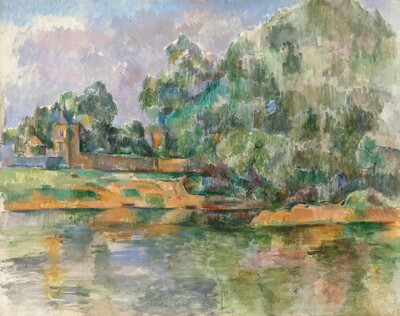
Chateau Noir, painted between 1900 and 1904, depicts the ruins of a 19th-century neo-Gothic mansion near Aix-en-Provence, a spot Cezanne visited repeatedly during the final years of his life. The chateau - never completed, abandoned by its eccentric builder, and slowly reclaimed by the surrounding forest - became one of Cezanne's most evocative subjects.
Cezanne painted Chateau Noir from multiple viewpoints throughout his career, producing at least four major oil paintings and several watercolors. This late version shows the building almost swallowed by the surrounding vegetation, its architectural forms dissolving into the same faceted planes of color that Cezanne applied to Mont Sainte-Victoire and the nearby quarries of Bibemus.
The painting exemplifies Cezanne's mature method: the building is constructed from patches of green, blue, and warm ochre, each stroke both describing a surface and asserting its own physical presence on the canvas. Architectural and natural forms interpenetrate; walls become trees, trees become walls, and the entire scene trembles between representation and abstraction. Cezanne wrote that he wanted to make of Impressionism something solid and durable - and Chateau Noir achieves this: a painting that feels as permanent as stone, even as it hovers on the edge of dissolution.
Cultural Impact
Cezanne's Chateau Noir paintings influenced the Cubists, who saw in his faceted surfaces the germ of their own revolution. Picasso and Braque recognized that Cezanne had discovered a way to represent the structural logic of the visible world without imitating its appearance - a discovery that made modern art possible.
Why It Matters
Chateau Noir is Cezanne's proof that the deepest art emerges from sustained attention to a single place. By painting this abandoned mansion over many years, he transformed it from a local curiosity into a monument of modern painting - a ruin that stands not as a reminder of the past but as a gateway to the future.