Provenance
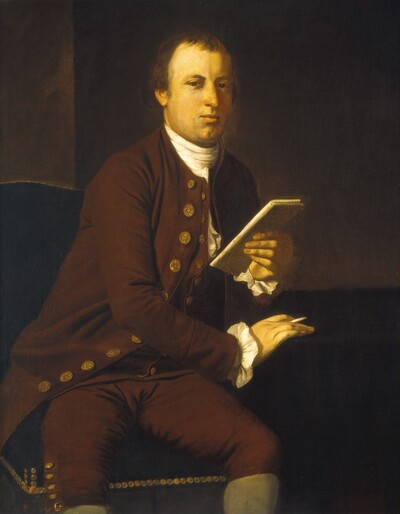
Brook Watson [1735-1807], London and East Sheen, Surrey; bequeathed to Christ's Hospital, London;[1] purchased 1963 by NGA.
[1] Watson's will, dated 12 August 1803, states: "I give and bequeath my Picture painted by Mr. Copley which represents the accident by which I lost my Leg in the Harbour of the Havannah in the Year One Thousand Seven Hundred and Forty Nine to the Governors of Christs Hospital to be delivered to them immediately after the Decease of my Wife Helen Watson or before if she shall think proper so to do hoping the said worthy Governors will receive the same as a testimony of the high estimation in which I hold that most Excellent Charity and that they will allow it to be hung up in the Hall of their Hospital as holding out a most usefull Lesson to Youth." (Public Record Office, London; copy, NGA curatorial file). The school's committee of almoners voted 28 September 1819 to accept the painting and place it in the great hall (minutes of a meeting of the Board of Almoners, Christ's Hospital, 28 September 1819; extract, NGA curatorial file). The hospital was founded in London in 1553 and was moved to Horsham, Essex, in 1902; _Encyclopaedia Britannica_ (11th ed., New York, 1910), 6: 295-296.
Accession Number
1963.6.1
Medium
oil on canvas
Dimensions
overall: 182.1 x 229.7 cm (71 11/16 x 90 7/16 in.) | framed: 241.3 x 264.2 x 10.1 cm (95 x 104 x 4 in.)
Classification
Painting
Credit Line
Ferdinand Lammot Belin Fund
Tags
Painting Neoclassical & Romantic (1751–1850) Oil Painting Canvas American
Background & Context
Background Story
Claude Monet Painting by the Edge of a Wood, painted in 1887, is John Singer Sargent's tribute to his friend and the most important influence on his artistic development. The painting depicts Monet at work en plein air, his easel set up at the edge of a glade, painting the landscape that surrounds him. The composition implicitly compares two painters: Monet, painting the landscape, and Sargent, painting Monet painting the landscape.
Sargent first met Monet in 1887, during a visit to Giverny. He was immediately captivated by Monet's method and his art, and the two painters developed a close friendship that lasted until Monet's death in 1926. Sargent purchased works by Monet, adopted his broken brushwork for his own landscape experiments, and even tried to work in series - all testimonies to the profound impact of Impressionism on his art.
The painting's most telling feature is its double vision. Sargent paints Monet's landscape in the Impressionist style - broken brushwork, saturated color, attention to the effects of light on foliage - while painting Monet himself in the more precise style of a figure study. The result is a painting about the act of painting: a portrait of the Impressionist method in action, rendered by an artist who admired it without fully adopting it.
Cultural Impact
Sargent's portrait of Monet painting is the most famous visual document of the Impressionist method at work and a testament to the cross-pollination between British and French painting that shaped the development of modern art. Its influence on the popular image of the Impressionist painter, working alone in nature, persists to this day.
Why It Matters
This painting captures the moment when two great painters acknowledge each other: Sargent, the master of the portrait, painting Monet, the master of the landscape, painting the landscape that made him what he is. The result is a portrait of influence - the most generous form of artistic appreciation.