Provenance
Probably acquired from (Ambroise Vollard [1866-1939], Paris) by Egisto Fabbri [1866-1933], Florence, until at least 1920.[1] (Paul Rosenberg and Co., London, New York, and Paris); sold 14 November 1927 to Chester Dale [1883-1962], New York;[2] gift 1963 to NGA.
[1]See John Rewald, _The Paintings of Paul Cézanne: a Catalogue Raisonn_, New York, 1996, no. 496. [2]According to Chester Dale papers in NGA curatorial file.
Accession Number
1963.10.103
Medium
oil on canvas
Dimensions
overall: 50.2 x 60 cm (19 3/4 x 23 5/8 in.) | framed: 70.5 x 81.3 cm (27 3/4 x 32 in.)
Classification
Painting
Credit Line
Chester Dale Collection
Tags
Painting Impressionist & Modern (1851–1900) Oil Painting Canvas French
Background & Context
Background Story
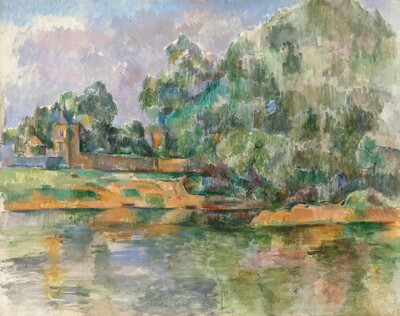
Landscape near Paris (c. 1876) belongs to Cézanne's Impressionist phase—the period when he was working closely with Pissarro and absorbing the landscape methods that the Impressionist movement had developed. The 1876 date places this during Cézanne's most productive Impressionist period, when he was painting at Pontoise and Auvers alongside Pissarro and learning the outdoor painting methods that would transform his art. The landscape near Paris—the Île-de-France scenery that the Impressionists had made their own—provided Cézanne with subjects that challenged his naturally constructive temperament. Where Monet and Pissarro pursued atmospheric dissolution, Cézanne was already seeking the underlying structures that atmospheric effects concealed. This tension—between Impressionist appearance and Cézanne's constructive inclination—would produce the most important developments in late 19th-century painting. The painting's handling likely shows the Impressionist influence that Pissarro's teaching had produced: shorter brushstrokes, a lighter palette, and more direct observation than Cézanne's earlier work had demonstrated. But beneath the Impressionist surface, the constructive tendencies that would define Cézanne's mature work are already visible: the landscape's forms are more solid, more structured, and more geometrically organized than Impressionist convention required. The painting thus documents the critical moment when Cézanne's distinctive approach began to emerge from Impressionist practice.
Cultural Impact
Cézanne's Impressionist landscapes influenced how the movement's relationship to Post-Impressionism was understood, documenting the moment when Cézanne's constructive method began to emerge from Impressionist atmospheric painting. The paintings influenced how Pissarro's teaching was evaluated, revealing the productive dialogue between two very different artistic temperaments. The landscape near Paris influenced how the Île-de-France tradition was extended through Post-Impressionist innovation.
Why It Matters
This painting matters because it captures the critical moment when Cézanne's distinctive approach began to emerge from his Impressionist apprenticeship—the landscape near Paris, painted alongside Pissarro, shows both the Impressionist surface and the constructive depth that would define Cézanne's most important contribution to art.