Provenance
Louis-Alfred Binant [1823-1904], Paris, by 1855;[1] (his sale, Hôtel Drouot, Paris, 20 April 1904, no. 18); purchased by (Bernheim-Jeune, Paris).[2] Léon Orosdi, Paris, sometime after 1913.[3] (Galerie André Weil, Paris);[4] (Etienne Bignou, Paris); sold 25 June 1934 to Chester Dale [1883-1962], New York; bequest 1963 to NGA.
[1] Alfred Robaut, _L'oeuvre de Corot_, Paris, 1905: II:90, no. 255. Lent by "M. Binand" to _Exposition de centenaire de Corot_, Palais Galliéra, Paris, 1895, no. 18; this seems likely to be a misspelling in the catalogue.
[2] Robaut 1905 (see note 1) and reported in the _New York Herald_, 21 April 1904.
[3] This painting was not included in the sale of Orosdi's collection held at Drouot on 25 May 1923.
[4] Orosdi/Galerie Weil provenance from Chester Dale papers in NGA curatorial records, and the Bignou photograph albums at the Documentation, Musée d'Orsay (copies in NGA curatorial files).
Accession Number
1963.10.109
Medium
oil on canvas
Dimensions
overall: 175.6 x 242.6 cm (69 1/8 x 95 1/2 in.) | framed: 196.9 x 262.9 cm (77 1/2 x 103 1/2 in.)
Classification
Painting
Credit Line
Chester Dale Collection
Tags
Painting Neoclassical & Romantic (1751–1850) Oil Painting Canvas French
Background & Context
Background Story
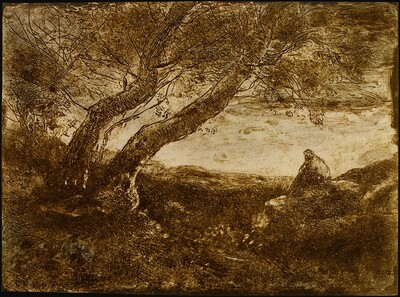
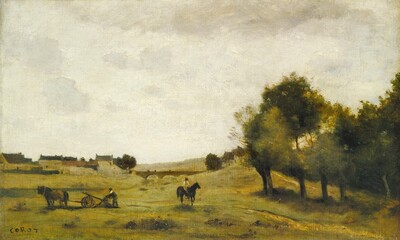
Forest of Fontainebleau (1834) represents Corot's early engagement with the forest that was central to the Barbizon tradition—the vast royal hunting preserve south of Paris that became the 19th century's most important landscape painting site. The 1834 date places this during Corot's formative period, when he was making the oil sketches in the Forest of Fontainebleau that would influence his development and, through him, the entire Barbizon movement. The forest's ancient trees, rocky outcroppings, and the particular quality of light filtering through dense canopy provided landscape subjects that were ideal for the outdoor painting method Corot was developing. The Forest of Fontainebleau had been a royal hunting preserve since the medieval period, and its ancient trees—some dating to the 16th century—provided landscape subjects that combined natural beauty with historical depth. Corot's 1834 treatment likely retains the directness of a painting made on location, before his later style had developed the atmospheric poetry that would characterize his mature work. The painting also connects to the emerging Barbizon community: by the 1830s, artists including Théodore Rousseau and Diaz de la Peña were beginning to work in the forest, establishing the Barbizon tradition that would make Fontainebleau the most important landscape painting site in France.
Cultural Impact
Corot's early Fontainebleau paintings influenced the development of the Barbizon school, establishing both the subject and the method that would define the movement. The paintings influenced how forests were represented in landscape art, moving from idealized settings to direct observation of specific forest environments. The Forest of Fontainebleau subject influenced how the French landscape tradition was connected to specific locations rather than to ideal compositions.
Why It Matters
This painting matters because it represents the early stage of the Barbizon tradition—the moment when Corot's direct observation of the Forest of Fontainebleau was establishing methods and subjects that would transform French landscape painting. Without these early forest studies, the Barbizon school would have lacked its most important precedent, and the Impressionist landscape that grew from it would have developed in a very different direction.