Provenance
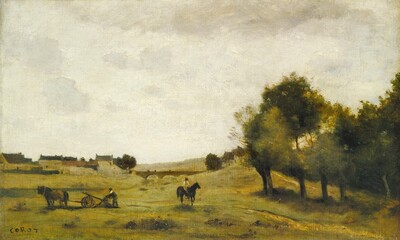
Baronne Thénard, Paris; (her estate sale, Hôtel Drouot, Paris, 19 November 1931, no. 22, as _Souvenir d'Italie_); purchased by (Paul Rosenberg et Cie., London, New York, and Paris); sold 2 November 1932 to Chester Dale [1883-1962], New York; bequest 1963 to NGA.
[1] Annotated copy of 1931 Hôtel Drouot sale catalogue in M. Knoedler & Co. library.
Accession Number
1963.10.111
Medium
oil on canvas
Dimensions
overall: 69.9 x 95.5 cm (27 1/2 x 37 5/8 in.) | framed: 94 x 120.3 cm (37 x 47 3/8 in.)
Classification
Painting
Credit Line
Chester Dale Collection
Tags
Painting Neoclassical & Romantic (1751–1850) Oil Painting Canvas French
Background & Context
Background Story
Portrait of Jeanne Hebuterne, painted around 1918, depicts the artist's companion and primary model during his final years. The painting exemplifies Modigliani's distinctive style: the elongated face, the almond-shaped eyes, the simplified features, and the sinuous line that transforms portraiture into sculptural abstraction.
Jeanne Hebuterne was a young art student when she met Modigliani in 1917. She was 19; he was 33, addicted to drugs and alcohol, and already dying of tuberculosis. Their relationship was intense and destructive: Modigliani painted Jeanne repeatedly, producing portraits that are among the most tender and most disturbing images of artistic devotion in modern art.
The painting's most striking feature is Jeanne's blank eyes - a signature of Modigliani's portraiture that has been endlessly interpreted. Some read it as inner vision, others as a mask concealing the sitter's identity. The blank eyes create an effect of extraordinary intimacy combined with radical distance: we see Jeanne clearly, but she does not see us.
Cultural Impact
Modigliani's portraits created one of the most recognizable styles in modern art: a synthesis of African sculpture, Renaissance proportion, and modernist simplification that influenced every subsequent painter who sought to combine likeness with abstraction.
Why It Matters
This painting captures the paradox of Modigliani's art: a portrait simultaneously intimate and abstract. Jeanne's elongated face and blank eyes embody the tension between love and distance, between seeing and being seen, that defined both Modigliani's art and his life.