Provenance
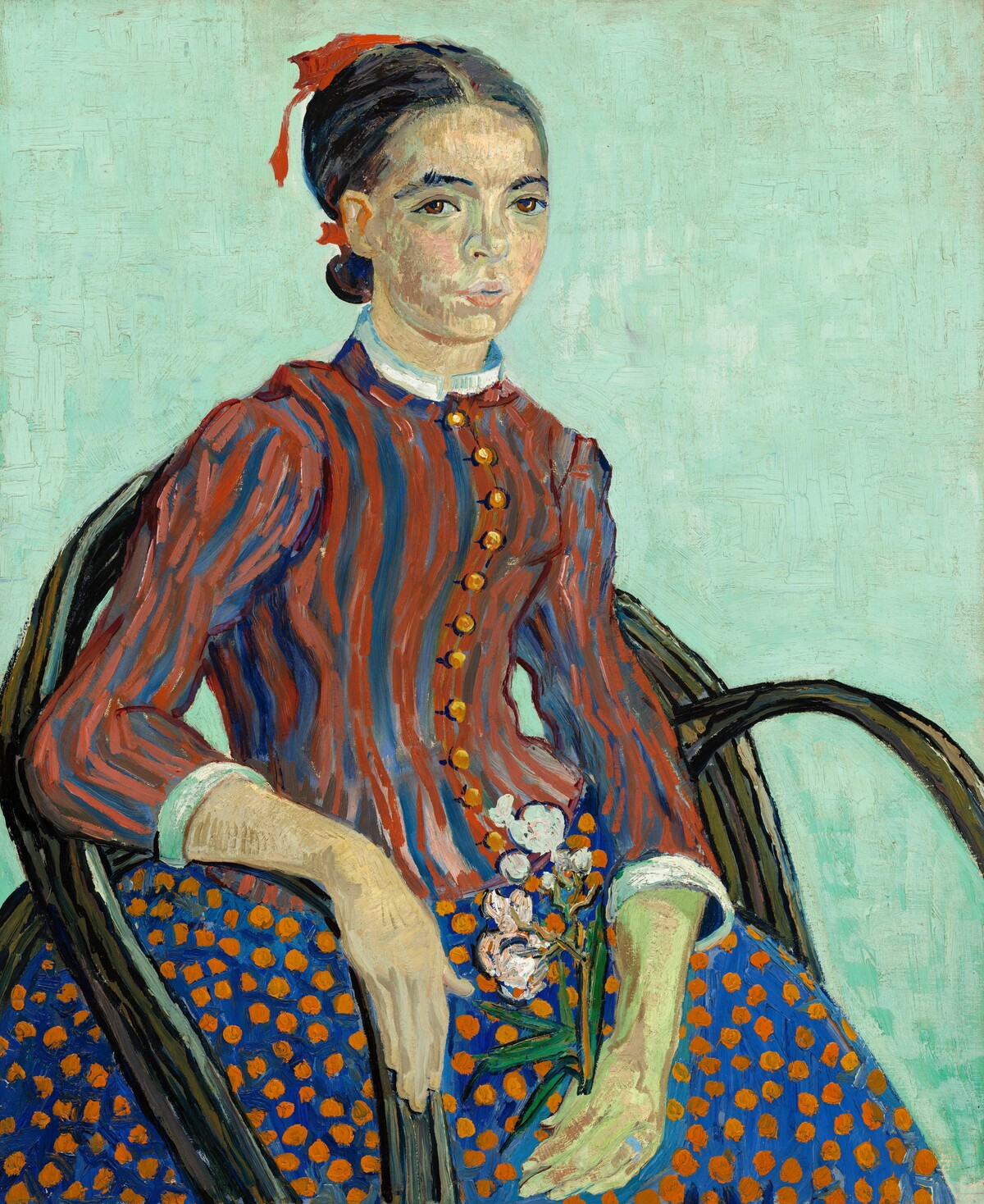
Mme Johanna van Gogh-Bonger, the artist's sister-in-law, Amsterdam;[1] sold May 1909 to (J.H. de Bois [C.M. van Gogh, Mme van Gogh-Bonger's uncle by marriage], The Hague); sold 1909 to Carl Sternheim [1878-1942], Munich and later La Hulpe, Belgium;[2] traded 1909 to (Bernheim-Jeune & Cie, Paris).[3] (Jos Hessel, Paris). (Paul Rosenberg and Co., Paris). Georges Bernheim, Paris. Alphonse Kann [1870-1948], Paris, by 1917.[4] J.B. Stang, Oslo;[5] sold 3 January 1928 through (Dr. Alfred Gold [1874-1958], Berlin) to (Alex Reid and Lefèvre, Ltd., Glasgow and London) on joint account with (M. Knoedler & Co., New York); sold 21 May 1929 through (Galerie Étienne Bignou, Paris) to Chester Dale [1883-1962], New York;[6] bequest 1963 to NGA.
[1] The painting is no. 169 in the Andries Bonger list of 1890, described as "Jeune fille à la fleur, toile de 25" ("Catalogue des oeuvres de Vincent van Gogh," manuscript b 3055 V/1962, Van Gogh Museum, Amsterdam; copy in NGA curatorial files).
[2] The painting sold for 3000 guilders, per Jan Frederik Heijbroek and E.L. Wouthuysen, _Kunst, kennis en commercie: de kunsthandelaar J.H. de Bois (1878-1946)_, Amsterdam, 1993:195, and Christ Stolwijk and Han Veenenbos, _The account book of Theo van Gogh and Jo van Gogh-Bonger_, Amsterdam and Leiden, 2002: 52 (17/12), 127 (92/10), 149, 172. See also Walter Feilchenfeldt, _Vincent van Gogh and Paul Cassirer, Berlin: The Reception of van Gogh in Germany from 1901-1914_, Zwolle, 1988: 94. A label from the "Kunsthandel C.M. van Gogh, Keizersgracht 953, Amsterdam" is on the back of the painting.
[3] Thea Sternheim, _Tagebücher 1905-1927. Die Jahre mit Carl Sternhaim_, Mainz, 1995: 25, mentions Carl trading the portrait to Bernheim-Jeune in exchange for a landscape. Bernheim-Jeune & Cie no. 16771 is per a label on the back of the painting. Hessel, Rosenberg and Georges Bernheim are per Chester Dale papers, in NGA curatorial files.
[4] The painting was lent by Kann to the 1917 exhibition _Französische Kunst des XIX. u. XX. Jahrhunderts_, Zürchner Kunsthaus, no.108, as _Fillette d'Arles_. There is also a partial label on the back of the painting that reads "Alph. Kann. van Gogh, Fillette d'Arles."
[5] The Stang collection was visited in January 1929 by Cesar de Hauke and Germain Seligmann, per the Seligmann papers, Archives of American Art, Smithsonian Institution, Washington: Box 208. The collection was described, and this painting reproduced, by Paul Jamot in "L'Art français en Norvège," _La Renaissance_ (February 1929). This painting, however, was already sold by Dr. Alfred Gold to Reid & Lefèvre by that time. See Reid & Lefèvre, Paintings Sold, sheet no. 161, #312/28 B1343, which records the date of purchase from Gold as 3 January 1928 (Lefèvre archives, Hyman Kreitman Research Centre, Tate Britain, London, TGA 2002/11, Box 283). Gold was selling pictures from the Stang collection over a number of years; see the Seligmann papers, Archives of American Art, Smithsonian Institution, Washington: Box 394. Copies of all the archival documents are in NGA curatorial files.
[6] The invoice dated 5 April 1929 from Bignou to Reid & Lefèvre for the re-framing of the painting suggests it was in Paris by that time (Lefèvre archives, Hyman Kreitman Research Centre, Tate Britain, London, TGA 2002/11, Box 180). On 29 May 1929, Bignou writes that he has shipped the picture to London (Lefèvre archives, Hyman Kreitman Research Centre, Tate Britain, London, TGA 2002/11, Box 218). Copies of the 1929 invoice and letter are in NGA curatorial files.
Accession Number
1963.10.151
Medium
oil on canvas
Dimensions
overall: 73.3 x 60.3 cm (28 7/8 x 23 3/4 in.) | framed: 99 x 86.3 x 10.1 cm (39 x 34 x 4 in.)
Classification
Painting
Credit Line
Chester Dale Collection
Background & Context
Background Story
Composition VII, painted in 1913, is Wassily Kandinsky's most ambitious abstract painting and a foundation work of non-representational art. The canvas is a whirlwind of colors, lines, and forms that collide and merge in a cosmic drama without identifiable subject matter. Kandinsky insisted it had specific spiritual content: a vision of the Deluge, the Resurrection, and the Last Judgment.
Kandinsky painted it in three days following months of preparatory studies. More than 30 sketches document how recognizable images - boats, animals, figures - transformed into pure abstraction.
The painting belongs to Kandinsky's most radical period, when he concluded that representational content obstructed spiritual effect. His theoretical book On the Spiritual in Art (1911) argued that color, line, and form could communicate directly with the soul. Composition VII is the fullest realization of this theory.
Cultural Impact
Composition VII established abstract painting as a vehicle for the most serious spiritual content. Kandinsky's demonstration that abstraction could be as profound as representation created the theoretical foundation for every subsequent non-representational art movement.
Why It Matters
This painting is the moment when Western art broke through to abstraction. Composition VII is a Deluge and Resurrection in pure color and form - proof that the spiritual is not the enemy of the visible but its destination.