Provenance
Mme Pontillon, sister of the artist, Paris; her daughter, Mme Forget, Paris; (Paul Rosenberg, Paris); sold 15 May 1930 to Chester Dale [1883-1962], New York; bequest 1963 to NGA.
Accession Number
1963.10.186
Medium
oil on canvas
Dimensions
overall: 101 x 81.8 cm (39 3/4 x 32 3/16 in.) | framed: 128.3 x 108.6 cm (50 1/2 x 42 3/4 in.)
Classification
Painting
Credit Line
Chester Dale Collection
Tags
Painting Impressionist & Modern (1851–1900) Oil Painting Canvas French
Background & Context
Background Story
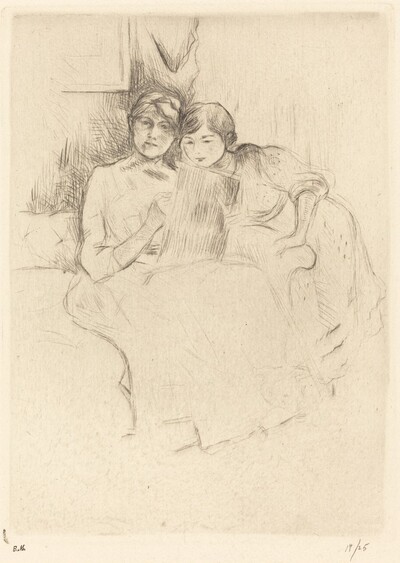
The Mother and Sister of the Artist, painted in 1869-1870, is Berthe Morisot's first major work and the painting that announced her as a significant talent. It depicts her mother, Marie-Cornelie Morisot, reading beside her sister Edma, who sits in a pose of relaxed introspection. The domestic interior, with its patterned wallpaper and carefully arranged furniture, creates an intimate space of female companionship.
The painting was accepted at the Paris Salon of 1870 - a significant achievement for a woman artist in a system designed to exclude them. Morisot exhibited at the Salon regularly before joining the Impressionists in 1874, and her acceptance gave her a legitimacy that protected her from the ridicule the male Impressionists initially suffered.
The painting's most modern feature is its handling of paint. The faces and hands are carefully modeled, but the dresses, the furniture, and the wallpaper dissolve into rapid, fluid strokes that anticipate the boldest passages of late Impressionism. Morisot's brushwork was always the most spontaneous of the Impressionist group - a quality that her contemporaries attributed to feminine intuition but that modern eyes recognize as a deliberate aesthetic choice: the refusal to finish what has already been said.
Cultural Impact
Morisot's Salon success demonstrated that a woman could meet the highest academic standards while developing a style that anticipated the most radical painting of the next decade. Her example opened a path for women artists that Mary Cassatt and Eva Gonzales would follow.
Why It Matters
This painting captures the world that Morisot made her own: the domestic interior as a space of both comfort and creative possibility. Her mother and sister, reading and thinking in their sitting room, are not decorative subjects but active minds - women whose interior lives are as rich and as various as any male artist's.