Provenance
Purchased from the artist 24 February 1892 by (Durand-Ruel, Paris);[1] sold 27 February 1911 to (Paul Cassirer, Berlin).[2] English private collection; purchased 1951 by (Marlborough Fine Art, London). (Arthur Tooth & Sons, London); sold 8 May 1952 to (Sam Salz, Inc., New York); sold September 1953 to Oscar Howalka; [3] (Sam Salz, Inc, New York); sold 9 June 1954 to Ailsa Mellon Bruce [1901-1969], New York;[4] bequest 1970 to NGA.
[1 ]Durand-Ruel stock number 2346 provided in letter dated 12 July 1983 from Charles Durand-Ruel.
[2] See letter dated 21 October 2000 from Walter Feilchenfeldt.
[3] Provenance from English private colletion to Howalka per Joachim Pissarro and Claire Durand-Ruel Snollaerts, _Pissarro: Catalogue critique des peintures_, 3 vols., Milan, Paris, and New York, 2005: III:no. 887.
[4] Dated receipt in NGA curatorial files.
Accession Number
1970.17.53
Medium
oil on canvas
Dimensions
overall: 54.3 x 73 cm (21 3/8 x 28 3/4 in.) | framed: 76.2 x 95.2 x 9.5 cm (30 x 37 1/2 x 3 3/4 in.)
Classification
Painting
Credit Line
Ailsa Mellon Bruce Collection
Tags
Painting Impressionist & Modern (1851–1900) Oil Painting Canvas French
Background & Context
Background Story
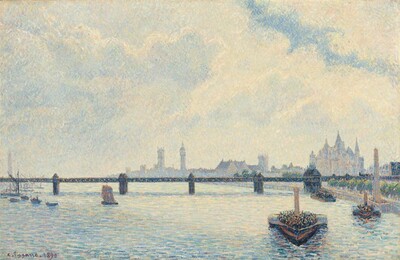
Hampton Court Green (1891) represents Pissarro's engagement with English landscape—a subject he explored during visits to London, where his son Lucian was studying art. Hampton Court, the Tudor palace on the Thames west of London, was a popular destination for Londoners seeking green space and historical interest. The green—the open parkland surrounding the palace—provided Pissarro with a landscape very different from his usual French rural subjects: formally landscaped English parkland rather than working French farmland. Pissarro's treatment of this English subject demonstrates how Impressionist principles could serve any landscape. The green's spacious expanse, its mature trees, and the palace visible in the distance create a composition that combines landscape with architectural elements within an atmospheric setting. The year 1891 was significant: Pissarro was experimenting with Neo-Impressionist pointillist technique (influenced by Seurat and Signac) but was also returning to a more fluid Impressionist handling. Hampton Court Green likely reflects this transitional approach—more systematically constructed than his earlier Impressionist work but more fluid than his strict Neo-Impressionist experiments. The English setting also connects Pissarro to the broader tradition of French artists working in Britain—from Monet's London series to the earlier French artists who had found subjects in English landscape.
Cultural Impact
Pissarro's English landscapes influenced how Impressionist principles were applied to British subjects, demonstrating that the movement's methods were not limited to French scenery. The paintings influenced later Anglo-French artistic exchange, establishing precedents for the mutual influence between French and British painting that characterized the late 19th and early 20th centuries. The Hampton Court subject influenced how English heritage sites were represented in art.
Why It Matters
This painting matters because it demonstrates the international adaptability of Impressionist method—Pissarro's technique serves English parkland as effectively as French farmland, arguing that the movement's perceptual principles are not culturally specific but universally applicable. The painting also reveals Pissarro's stylistic experimentation during a crucial transitional period.