Provenance
(Ambroise Vollard [1866-1939], Paris). Capt. Edward H. Molyneux [1891-1974], Paris, by 1952;[1] sold 15 August 1955 to Ailsa Mellon Bruce [1901-1969], New York; bequest 1970 to NGA.
[1]Exhibited as part of the Molyneux collection in 1952 at the National Gallery of Art.
Accession Number
1970.17.72
Medium
oil on canvas
Dimensions
overall: 11.5 x 16.5 cm (4 1/2 x 6 1/2 in.) | framed: 27.9 x 31.8 x 4.1 cm (11 x 12 1/2 x 1 5/8 in.)
Classification
Painting
Credit Line
Ailsa Mellon Bruce Collection
Tags
Painting Impressionist & Modern (1851–1900) Oil Painting Canvas French
Background & Context
Background Story
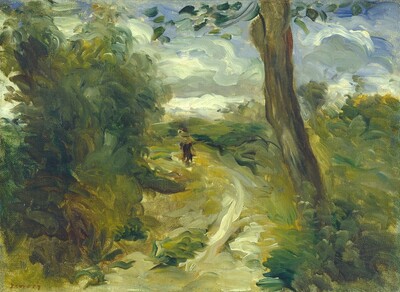
Landscape at Vétheuil (c. 1890) depicts the Seine-side village that was one of the most important locations in the history of Impressionist landscape painting. Vétheuil, where Monet lived from 1878 to 1881 and produced some of his most innovative winter and spring landscapes, provided Renoir with a subject loaded with artistic significance. The 1890 date places this during the period when Renoir was reassessing his relationship to Impressionist landscape—moving toward a more classical handling while retaining the color innovations that Impressionism had developed. Vétheuil's specific landscape—the Seine curving below the village, the Île Mouchelle (now Île l'Aumône) with its poplars, and the chalk cliffs rising behind the church—provided a subject that both artists had painted, and Renoir's treatment offers an implicit comparison with Monet's. Where Monet had pursued the atmospheric dissolution of form, Renoir maintained a more structured approach: the landscape's forms are legible, the spatial depth is convincing, and the handling combines Impressionist color with a drawing precision that Monet had abandoned. The painting also documents Vétheuil at a specific historical moment—the 1890s, before the village's transformation into a Parisian suburb would alter its rural character.
Cultural Impact
Renoir's Vétheuil landscape influenced how Impressionist landscape was understood in its later phases, demonstrating that Impressionist color could coexist with structural drawing. The painting influenced how the Seine valley was represented in French art, documenting a location that was central to Impressionist landscape history. The landscape also influenced how Renoir's development was perceived, revealing his movement toward a more classical approach.
Why It Matters
This painting matters because it represents Renoir's engagement with one of Impressionism's most important locations—the Seine-side village where Monet had produced revolutionary landscapes—with a handling that demonstrates the range of Impressionist landscape practice, arguing that Impressionism's significance lay in its color innovations rather than in the dissolution of form that Monet had pursued.