Provenance
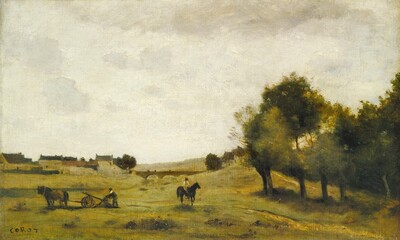
F. Stumpf, Paris; (Stumpf sale, Hôtel Drouot, Paris 27 November 1894, no. 19, as _Marine_); purchased by (F. and J. Tempelaere, Paris).[1] Aimé Diot [d. 1896], Paris; (his sale, Hôtel Drouot, Paris, 8 March 1897, no. 35, as _Falaises_). Nicolas Auguste Hazard [1834-1913], Paris; (Hazard sale, Galerie Georges Petit, Paris, 3 December 1919, no. 91, as _La Plage_); purchased by Rosenthal, Paris; (Rosenthal sale, Paris, 9 May 1934, no. 67); purchased by Dr. George Viau [1855-1939], Paris; (his estate sale, part I, 11 December 1942, no. 81).[2] Baron Pellenc, Paris, in 1944. André Schoëller [1879-1955], Paris, in 1945.[3] Captain Edward H. Molyneux [1891-1974], Paris, by 1952;[4] sold 1955 to Ailsa Mellon Bruce [1901-1969], New York; bequest 1970 to NGA.
[1] Letter from Jean Dieterle, peintre-expert, dated 11 September 1970, in NGA curatorial files, gives Tempelaere as purchaser.
[2] According to press reports and an annotated sales catalogue, copy in NGA curatorial records, the picture sold for 560,000 francs to an unnamed purchaser.
[3] Pellenc and Schoeller per Dieterle letter cited in note 1. Schoeller acted as expert at the 1942 Viau sale.
[4] Exhibited in _French Paintings from the Molyneux Collection_, National Gallery of Art, Washington, D.C., 1952.
Accession Number
1970.17.117
Medium
oil on canvas
Dimensions
overall: 12.3 x 25.5 cm (4 13/16 x 10 1/16 in.) | framed: 25.4 x 38.1 x 3.2 cm (10 x 15 x 1 1/4 in.)
Classification
Painting
Credit Line
Ailsa Mellon Bruce Collection
Tags
Painting Impressionist & Modern (1851–1900) Oil Painting Canvas French
Background & Context
Background Story
The Breakfast Room, painted around 1903, is one of Edouard Vuillard's most accomplished interior paintings and a masterwork of the Intimist style he developed with Pierre Bonnard. The painting depicts a domestic interior bathed in morning light, its patterned wallpaper, carpet, and tablecloth creating a field of visual complexity that nearly overwhelms the human figures who inhabit it.
Vuillard lived with his mother, a dressmaker, until her death in 1928, and the apartments and workshops they shared provided his most consistent subject. His interiors are not spaces where things happen but spaces where patterns happen: the floral wallpaper, the figured carpet, the checked tablecloth, and the clothing of the figures create a visual environment so dense that the distinction between figure and ground begins to dissolve.
The Breakfast Room exemplifies Vuillard's most radical contribution to painting: the elimination of the hierarchy between figure and setting. In his interiors, the people are no more important than the wallpaper; the tablecloth is as significant as the face. This democratic treatment of the visual field - where nothing is privileged and everything is equally attended to - anticipates the all-over composition of Abstract Expressionism and the flat picture plane of mid-century modernism.
Cultural Impact
Vuillard's Intimist paintings demonstrated that the most radical formal innovations could emerge from the most private, most domestic subjects. His dissolution of figure into pattern influenced Matisse, the Nabis, and every painter who found in the domestic interior the same formal challenges that the landscape presented to the Impressionists.
Why It Matters
The Breakfast Room captures Vuillard's central discovery: that a domestic interior is not a background for life but a participant in it. The wallpaper, the carpet, the tablecloth are not decoration but structure - the visual architecture of daily existence, painted with the attention traditionally reserved for the sublime.