Provenance
Mrs. William J. Crowell, the artist's sister, Avondale, Pennsylvania; her son, James W. Crowell [1888-1954], Claremont, California. (Babock Galleries, New York); sold May 1944 to (M. Knoedler & Co., New York); sold April 1946 to Charles G. Lang [1890-1956], Baltimore; consigned 1950 to (M. Knoedler & Co., New York); sold May 1954 to John Hay Whitney [1904-1982], Manhasset, New York; [1] deeded 1982 to the John Hay Whitney Charitable Trust, New York; gift 1982 to NGA.
[1] M. Knoedler & Co. Records, accession number 2012.M.54, Research Library, Getty Research Institute, Los Angeles: Stock book no. 9, no. A2913; Consignment book no. 4, no. CA3641; Sales book no. 17, no. CA3641 (copies in NGA curatorial files).
Accession Number
1982.76.5
Medium
oil on canvas
Dimensions
overall: 81.9 x 122.8 cm (32 1/4 x 48 3/8 in.) | framed: 106.7 x 147.3 cm (42 x 58 in.)
Classification
Painting
Credit Line
John Hay Whitney Collection
Tags
Painting Impressionist & Modern (1851–1900) Oil Painting Canvas American
Background & Context
Background Story
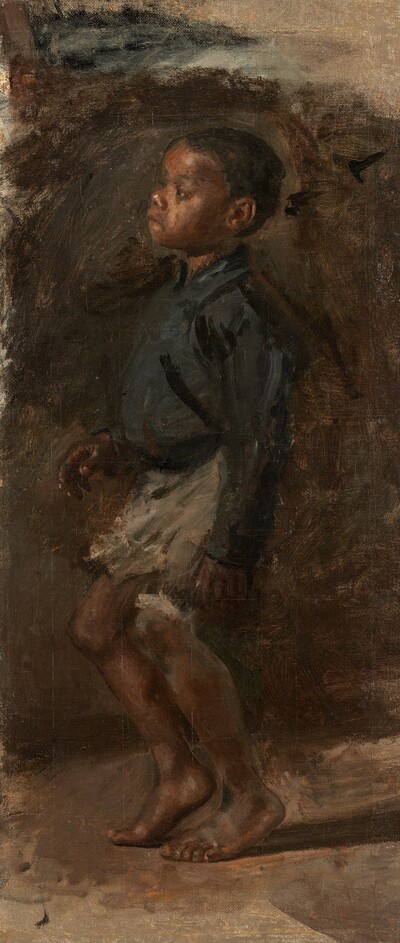
Baby at Play (1876) depicts a child intensely focused on play—specifically, stacking blocks or manipulating toys—captured with Eakins's characteristic observational precision. This painting represents Eakins's engagement with childhood as a subject for serious artistic investigation rather than sentimental illustration. Most 19th-century child portraiture idealized children as angels, innocents, or decorative objects; Eakins paints a real child engaged in a real activity, concentrating with the same intensity that Eakins himself brought to his work. The child's absorption in play becomes a subject worthy of the same technical mastery Eakins applied to surgical operations and athletic competitions. The painting's composition likely places the child at the center of the pictorial field with minimal distraction, emphasizing the intensity of focus that transforms play into something approaching work. The 1876 date places this work during America's Centennial year, when national self-reflection encouraged artists to explore American subjects—including American childhood—through new lenses. Eakins's approach to the child anticipates developmental psychology's insights about play as cognitive work by several decades. The painting also reflects Eakins's own experience as a father and his conviction that close observation reveals truth about any subject, however apparently trivial.
Cultural Impact
Baby at Play influenced how childhood was represented in American art, establishing a tradition of psychological rather than sentimental child portraiture that would influence Mary Cassatt's later work and 20th-century child photography. The painting also influenced educational philosophy by treating play as a serious cognitive activity—an insight that would become central to progressive education. Eakins's unidealized approach to childhood influenced later American Realist painters who similarly refused to sentimentalize children.
Why It Matters
This painting matters because it demonstrates Eakins's conviction that every human activity—whether surgical, athletic, or playful—deserves the same rigorous attention. A baby stacking blocks receives the same technical mastery and psychological insight as a surgeon performing an operation. This democratic vision of attention—refusing to rank subjects by conventional importance—remains a radical principle in an art world that still values some subjects above others.