Accession Number
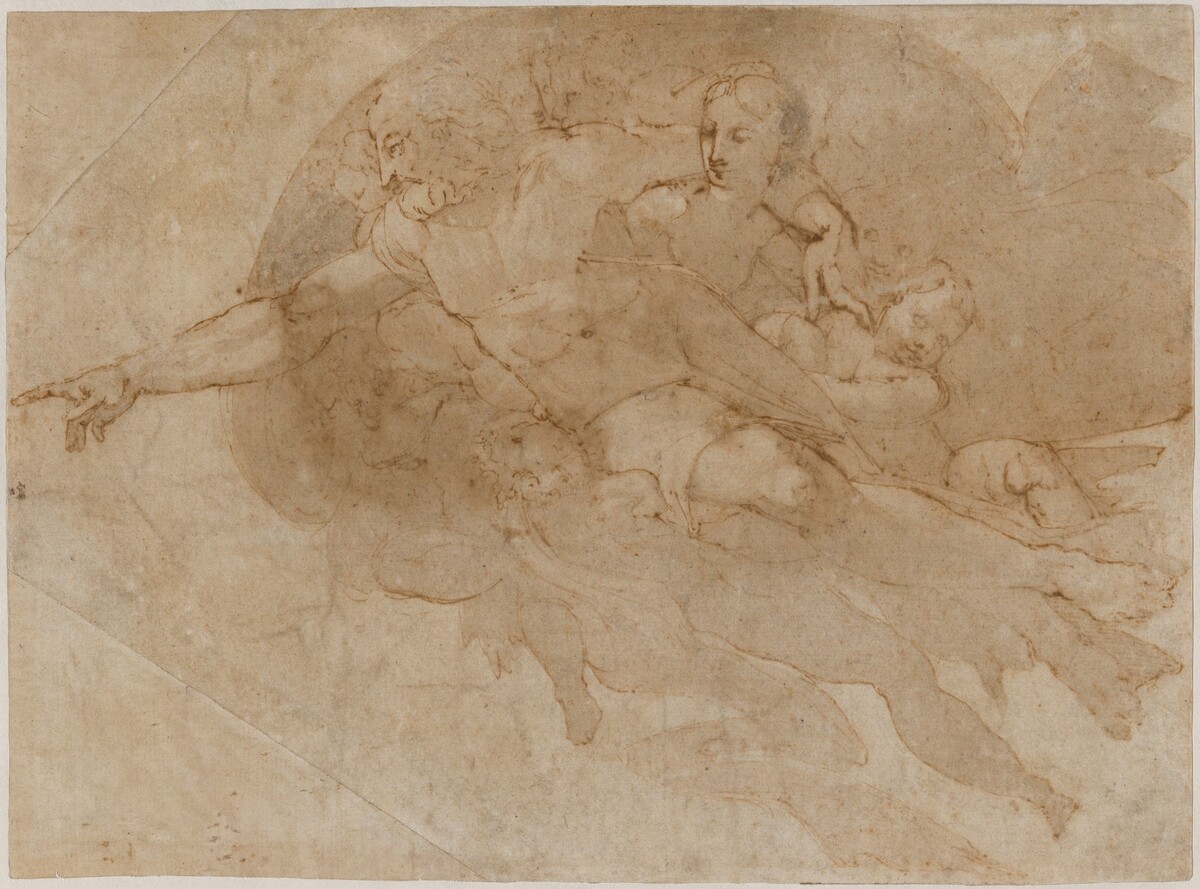
1982.79.1
Medium
pen and brown ink with brown wash on laid paper
Dimensions
overall: 18 x 24.4 cm (7 1/16 x 9 5/8 in.)
Classification
Drawing
Credit Line
Gift of Charles Parkhurst
Background & Context
Background Story
Beach Scene at Trouville, painted around 1864-1867, is typical of Eugene Boudin's most characteristic subject: the fashionable beach resorts of Normandy, where Parisians escaped the city during the summer months. Small figures in elaborate dress stroll along the shoreline or sit under striped tents, their parasols and crinolines punctuating a landscape of sand, sea, and cloud.
Boudin was the first painter to make the beach resort a serious subject for art, and his influence on the young Claude Monet - whom he persuaded to paint en plein air in 1858 - was decisive for the development of Impressionism. Monet later acknowledged that he owed everything to Boudin, who taught him to see and to paint the transient effects of light and atmosphere.
The painting's most modern feature is its treatment of the figures, which are rendered as rapid notations of color rather than as individual portraits. Boudin's beach-goers are elements in a larger composition of light and atmosphere: their parasols and dresses create patterns against the sand and sky, and their smallness emphasizes the vastness of the natural world that surrounds them. The clouds, painted with Boudin's characteristic skill, are the true subject - vast, luminous formations that dominate the canvas as they dominated the Norman sky.
Cultural Impact
Boudin's beach scenes created a new genre in French painting and directly influenced the development of Impressionism. His demonstration that the most transient effects of light and weather could be captured in paint - and that a fashionable beach could be as worthy of artistic attention as a classical landscape - opened the door to Monet's revolutionary work.
Why It Matters
This painting captures Boudin's central insight: that the beauty of a Norman beach lies not in its permanent features but in the light, the clouds, and the atmosphere that pass over it. The fashionable figures are witnesses to this beauty - tiny, ephemeral, and as transient as the weather that surrounds them.