Provenance
Purchased from the artist by (Amboise Vollard [1866-1939], Paris); (Hector Brame, Paris); sold November 1963 to Mr. and Mrs. Paul Mellon, Upperville, Virginia; gift 1983 to NGA.
Accession Number
1983.1.18
Medium
oil on canvas
Dimensions
overall: 89.5 × 129.8 cm (35 1/4 × 51 1/8 in.) | framed: 109.22 × 152.72 × 6.35 cm (43 × 60 1/8 × 2 1/2 in.)
Classification
Painting
Credit Line
Collection of Mr. and Mrs. Paul Mellon
Tags
Painting Impressionist & Modern (1851–1900) Oil Painting Canvas American
Background & Context
Background Story
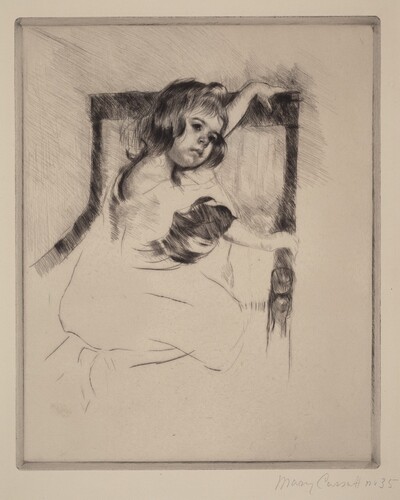
Little Girl in a Blue Armchair is one of Mary Cassatt's most radical paintings and a landmark of Impressionist interior painting. It depicts a small girl - the daughter of friends of the artist - slumped in a blue armchair in a Parisian drawing room, her legs stretched out, her small dog asleep beside her. Behind her, additional chairs recede into the room, their shapes slightly歪 in perspective.
The painting's unconventional composition and its deliberately un-posed subject caused confusion when it was first exhibited. The girl is not a cherubic ideal but a real child: bored, tired, waiting. The tilted perspective and the repeated curves of the armchairs create a visual instability that suggests the subjective experience of the room from a child's height. Degas, who admired the painting, reportedly contributed to its background, and his influence is visible in the unusual viewpoint.
Cassatt painted this in 1878, the year she was invited to join the Impressionist group. It was a declaration of independence from academic painting: proof that a woman artist working in the domestic sphere could be as formally innovative as any male painter working in the cafe or the studio.
Cultural Impact
Little Girl in a Blue Armchair established a new visual language for representing children - one based on observation rather than idealization. Its radical perspective and psychological honesty influenced generations of artists, from Bonnard to contemporary photographers of domestic life.
Why It Matters
This painting is Cassatt's manifesto: the argument that the private, feminine world is not a limitation on artistic ambition but a source of formal innovation. The tilted perspective, the repeated curves, the unconventional cropping - all derive from the artist's commitment to seeing the world from a woman's and a child's point of view.