Provenance
Baron Louis de Rothschild [1882-1955], Vienna.[1] his niece, Baroness Reininghaus [née Bettina Rothschild Springer, 1912-1974]; her husband, Baron Kurt Reininghaus [d. 1984]; sold to (Galerie Sanct Lucas, Vienna); sold c. 1994 to Mr. and Mrs. Philip Cunningham, Alexandria, Virginia; partially sold and partially given 1996 through (Otto Naumann, New York) to NGA.
[1] This painting was confiscated by the Nazis from the Louis de Rothschild collection in Vienna in 1938 and was destined for Adolf Hitler's planned museum in Linz, Austria. It is listed on the 20 October 1939 _Vorschlag sur Verteilung der in Wien beschlagnahmte Gemaelde: Für das Kunstmuseum in Linz_ prepared by Hitler's curator, Hans Posse, and also Posse's _Verzeichnis der für Linz in Aussicht genommenen Gemälde_ dated 31 July 1940 (OSS Consolidated Interrogation Report #4, Linz: Hitler's Museum and Library, 15 December 1945, Attachments 72 and 73, U.S. National Archives RG226/Entry 190B/Box 35, copy in NGA curatorial files). The records of the Allies' Munich Central Collecting Point indicate that the painting was recovered by the Allies and restituted to Austria on 11 May 1948. It was returned to Louis de Rothschild in 1949 (Munich property card #1665; Austrian Receipt for Cultural Property dated 11 May 1948; copies in NGA curatorial files.). The painting is listed and illustrated in Birgit Schwarz, _Hitlers Museum: Die Fotoalben Gemäldegalerie Linz: Dokumente zum “Führermuseum”_, Vienna, 2004: no. V/1. See also Sophie Lillie, _Was Einmal War_, Vienna, 2003: 113-116.
Accession Number
1996.80.1
Medium
oil on panel
Dimensions
overall: 78.7 x 61.3 cm (31 x 24 1/8 in.) | framed: 104.1 x 86.4 x 7.6 cm (41 x 34 x 3 in.)
Classification
Painting
Credit Line
Patrons' Permanent Fund and Gift of Philip and Lizanne Cunningham
Tags
Painting Baroque (1600–1750) Oil Painting Panel Painting Dutch
Background & Context
Background Story
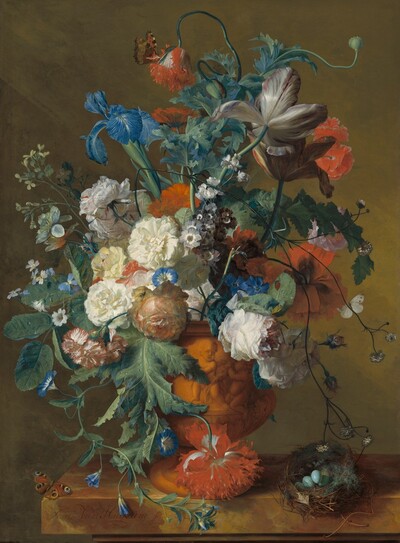
Jan van Huysum (1682-1749) was a Dutch painter known as the most accomplished flower and fruit still life painter of the Dutch Golden Age, whose precisely observed, brilliantly colored bouquets make him one of the most important still life painters in the history of art. Still Life with Flowers and Fruit from c. 1715 depicts flowers and fruit in the precisely observed, brilliantly colored manner that distinguishes van Huysum's best work from the more restrained still life painting of his Dutch predecessors. The c. 1715 date places this early in van Huysum's most productive period, when he was developing the precisely observed, brilliantly colored manner that would make him the most accomplished flower and fruit still life painter of the Dutch Golden Age.
Cultural Impact
Still Life with Flowers and Fruit is important in the history of Dutch still life painting because it demonstrates the precisely observed, brilliantly colored manner that van Huysum brought to flower and fruit subjects as the most accomplished still life painter of the Dutch Golden Age. Van Huysum's flower and fruit still lifes—combining precise botanical observation with brilliant color and elegant composition—represent the most accomplished tradition in Dutch still life painting, and the c. 1715 painting shows this tradition in its early phase.
Why It Matters
Still Life with Flowers and Fruit is van Huysum's brilliant Dutch still life: flowers and fruit rendered in the precisely observed, brilliantly colored manner of the most accomplished flower and fruit still life painter of the Dutch Golden Age. The c. 1715 painting shows the beginning of the tradition that would make van Huysum the most accomplished still life painter of the 18th century.