
Provenance
The estate of the artist, 1901;[1] Maurice Joyant [1864-1930]; by whom bequeathed to Mme M.G. Dortu;[2] sold 1 August 1950 through (Hector Brame, Paris)[3] to Mr. and Mrs. John Hay Whitney, New York; gift (partial and promised) 1990 to NGA; gift completed 1998..
[1]The painting bears the estate stamp (the monogram HTL in a circle, in red) at the lower left corner. [2] Joyant bequest to Madame Dortu according to _The John Hay Whitney Collection_, The Tate Gallery, London, 1961. Madame Dortu lent the painting to a 1931 exhibition. [3]See Whitney records now in NGA curatorial files.
Accession Number
1990.127.1
Medium
oil on canvas
Dimensions
overall: 145 x 149 cm (57 1/16 x 58 11/16 in.) | framed: 174.6 x 175.3 x 9.5 cm (68 3/4 x 69 x 3 3/4 in.)
Classification
Painting
Credit Line
Collection of Mr. and Mrs. John Hay Whitney
Tags
Painting Impressionist & Modern (1851–1900) Oil Painting Canvas French
Background & Context
Background Story
Marcelle Lender Dancing the Bolero in Chilpéric (1895-1896) is one of Toulouse-Lautrec's most celebrated theatrical paintings, depicting the dancer and actress Marcelle Lender performing in the operetta Chilpéric at the Théâtre des Variétés. The painting belongs to Toulouse-Lautrec's series of theatrical subjects—works that captured the specific quality of Parisian popular entertainment at the end of the 19th century. Marcelle Lender, with whom Toulouse-Lautrec was briefly infatuated, was a versatile performer known for her dancing and her presence in operetta and café-concert. His treatment of her dancing the bolero captures the specific choreography of the performance—her arms extended, her costume elaborate, her movement precisely rendered—demonstrating the artist's ability to record dance with the precision of someone who had studied movement's mechanics. The 1895-96 date places this during Toulouse-Lautrec's most productive theatrical period, when he was attending performances nightly and producing paintings and lithographs that documented the theatrical world with unprecedented specificity. His viewpoint—likely from a box or the front rows—provided the perspective that distinguished his theatrical work from the stage-front views that conventional theatrical painting offered. The painting's brilliant color—the reds, yellows, and blacks of the bolero costume against the stage's atmospheric lighting—demonstrates Toulouse-Lautrec's ability to render theatrical light with chromatic richness.
Cultural Impact
Toulouse-Lautrec's theatrical paintings influenced how Parisian popular entertainment was represented in art, establishing conventions for depicting theatrical performance from specific viewpoints. The paintings influenced later artists who similarly documented popular entertainment—from the Weimar cabaret painters to contemporary photographers of performance. The Marcelle Lender painting influenced how dance was represented in visual art, capturing specific choreography with unprecedented precision.
Why It Matters
This painting matters because it captures a specific performance by a specific dancer at a specific moment—the bolero in Chilpéric, danced by Marcelle Lender—and does so with the precision and passion that make it simultaneously a document of Parisian popular culture and a work of extraordinary artistic power. The painting argues that popular entertainment deserves the same artistic attention that high culture traditionally received.
Related Artworks
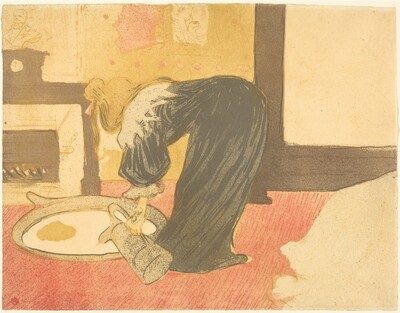
Woman at the Tub (Femme au tub)
Toulouse-Lautrec, Henri de

Guy and Mealy in "Paris qui marche" (Guy et Mealy dans "Paris qui marche")
Toulouse-Lautrec, Henri de
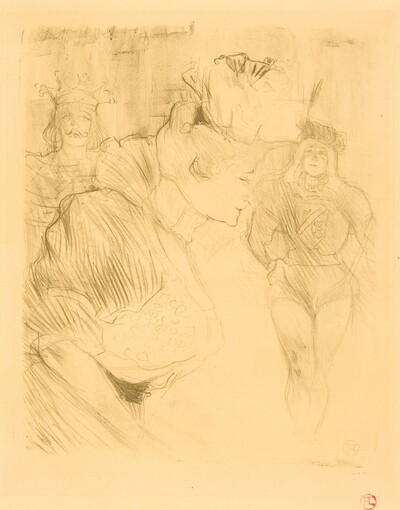
Lender Bowing (Lender saluant)
Toulouse-Lautrec, Henri de

Rejane and Galipaux in "Madame Sans-Gêne" (Réjane et Galipaux dans "Madame Sans-Gêne")
Toulouse-Lautrec, Henri de