Provenance
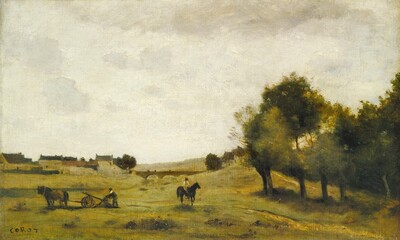
Private collection, France; (sale, Hôtel Drouot, Paris, 16 November 1917, no. 19, as attributed to Corot, bought in). Henri Vever [1854-1942], Paris.[1] Private collection, Boston. (Wildenstein & Co., New York); sold 1986 to Dr. Gert-Rudolf Flick [b. 1943], London. Private collection, Japan, by 1996;[2] (Wildenstein & Co., New York); purchased 2 February 2001 by NGA.
[1] This painting was not included in the Vever sale in Paris of 1-2 February 1897, which included 14 other paintings by Corot. It is unclear if Vever bought it at the 1917 auction, as his Acquisitions Book (in the Henri Vever papers, Freer-Sackler Gallery Archives, Smithsonian Institution, Washington) ends in July 1917.
[2] According to the exhibition catalogues, the painting was lent in 1989 to The Lefevre Gallery in London by a private collection in the United Kingdom, in 1991 to a touring exhibition in Manchester and Norwich by a private collection in Switzerland, and in 1996 to a touring exhibition in Washington, Brooklyn, and St. Louis by a private collection in Japan.
Accession Number
2001.23.1
Medium
oil on paper on canvas
Dimensions
overall: 27 x 43.2 cm (10 5/8 x 17 in.) | framed: 50.8 x 66.4 x 7.6 cm (20 x 26 1/8 x 3 in.)
Classification
Painting
Credit Line
Patrons' Permanent Fund
Tags
Painting Neoclassical & Romantic (1751–1850) Oil Painting Canvas French
Background & Context
Background Story
Fox Hunt, painted in 1893, is one of Homer most dramatic works and a painting that marks the full emergence of his late style. It depicts a fox running across a snowy landscape, pursued by a flock of crows that dive and harass the exhausted animal. The painting harsh winter setting and its ruthless depiction of the struggle for survival represent Homer most unsentimental vision of nature.
Homer painted Fox Hunt during the period when he had settled permanently in Prouts Neck, Maine, and was producing the seascapes and winter subjects that defined his late career. The painting was immediately controversial: some viewers found it too brutal, others too naturalistic. But Homer, who had witnessed the Civil War and the North Sea storms, had no interest in sentimentalizing nature.
The painting composition creates an almost cinematic sense of motion. The fox, low and exhausted, runs diagonally across the canvas, while the crows wheel above against a bleak winter sky. The snow, rendered in thick, textured paint, creates a surface of extraordinary physicality. Homer late style, with its large forms, its simplified compositions, and its refusal of anecdote, anticipates the 20th century most austere realists.
Cultural Impact
Fox Hunt established the theme of nature as a site of relentless struggle that would define Homer late career and influence the tradition of American realism from Edward Hopper to Andrew Wyeth. Its unsentimental treatment of the predator-prey relationship challenged the Victorian conventions of animal painting and created a new kind of naturalist art.
Why It Matters
This painting captures Homer most uncompromising vision: nature without consolation, struggle without moral. The fox and the crows are not good or evil; they are alive, and their struggle is the condition of life. Homer snow, his sky, and his exhausted fox record a truth as ancient as nature itself.