Provenance
M. Berend, Paris, by 1886.[1] (Durand-Ruel, Paris), c. 1900; (Durand-Ruel, New York), by 1903; purchased 18 January 1909 by the Corcoran Gallery of Art, Washington; acquired 2014 by the National Gallery of Art.
[1] Berend was the lender of the painting to the Eighth Impressionist Exhibition in 1886.
Accession Number
2014.79.9
Medium
oil on canvas
Dimensions
overall: 100.3 x 64.7 cm (39 1/2 x 25 1/2 in.) | framed: 133.99 × 96.52 × 12.7 cm (52 3/4 × 38 × 5 in.)
Classification
Painting
Credit Line
Corcoran Collection (Museum Purchase, Gallery Fund)
Tags
Painting Impressionist & Modern (1851–1900) Oil Painting Canvas American
Background & Context
Background Story
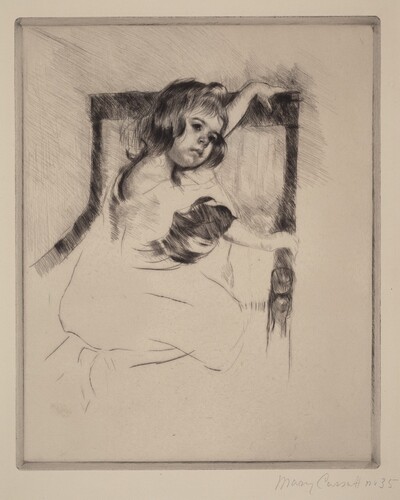
Young Girl at a Window from c. 1883-84 is one of Cassatt's most characteristic compositions: a woman or child seated at a window, the domestic interior contrasted with the world outside. The window motif was one of Cassatt's most persistent subjects—it appears in paintings, pastels, and prints throughout her career—because it allowed her to explore the boundary between women's domestic world and the public world that lay beyond it. The young girl at the window is simultaneously inside the domestic space and looking out at the larger world, a position that Cassatt understood from her own experience as a woman artist in a male-dominated profession.
Cultural Impact
Cassatt's window paintings are among the most important works in the history of feminist art criticism because they explore the boundary between women's domestic space and the public world that lies beyond it. Young Girl at a Window is not just a portrait of a child but a meditation on the relationship between domestic confinement and public aspiration—a subject that Cassatt, as a woman artist who had to fight for professional recognition, understood from personal experience.
Why It Matters
Young Girl at a Window is Cassatt's most characteristic composition: the boundary between domestic space and public world explored through a girl looking out from the confinement of the interior. The window motif is Cassatt's metaphor for women's experience—simultaneously inside and outside, confined and aspiring, domestic and public.