Provenance
Purchased 1822 by William Collins. Thomas Wilson, until 1848. John Naylor, until 1889; John M. Naylor; (his sale, Leighton Hall, Welshpool, 23 January 1923, no. 41). Anonymous gift 1924 to the United Grand Lodge of England; purchased 28 May 2004 through (Thomas Agnew & Sons, Ltd.) by NGA.
Accession Number
2004.64.1
Medium
oil on canvas
Dimensions
overall: 150 x 231 cm (59 1/16 x 90 15/16 in.)
Classification
Painting
Credit Line
Paul Mellon Fund
Tags
Painting Neoclassical & Romantic (1751–1850) Oil Painting Canvas British
Background & Context
Background Story
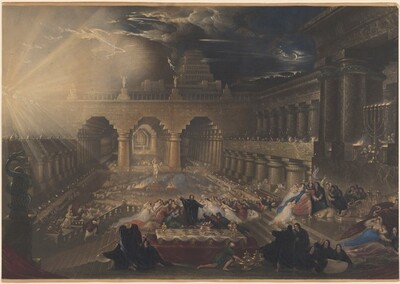
John Martin (1789-1854) was an English painter known for his vast, apocalyptic landscapes that depict biblical catastrophes on a scale that made him one of the most popular and controversial painters of the Romantic period. Joshua Commanding the Sun to Stand Still upon Gibeon from 1816 depicts the biblical episode in which Joshua commands the sun to stand still so that the Israelites can defeat their enemies, rendered with the vast scale and dramatic lighting that distinguish Martin's most ambitious compositions. The 1816 date places this among the earliest of Martin's great biblical subjects, painted the same year as his more famous Belshazzar's Feast.
Cultural Impact
Joshua Commanding the Sun to Stand Still is one of Martin's earliest great biblical subjects and demonstrates the vast scale and dramatic lighting that would make him the most popular painter of the apocalyptic sublime in the Romantic period. The painting's combination of biblical narrative and sublime landscape created a new type of history painting that substituted natural cataclysm for human drama, and the 1816 date places this at the beginning of the most productive period of Martin's career.
Why It Matters
Joshua Commanding the Sun to Stand Still is Martin's apocalyptic sublime at its most dramatic: the biblical episode rendered with the vast scale and dramatic lighting that made him the most popular painter of catastrophes in the Romantic period. The 1816 painting substitutes natural cataclysm for human drama in a new type of history painting.