Provenance
Theo van Gogh, Paris [1857-1891]; his widow, Joanna van Gogh-Bonger [1862-1925], Amsterdam; (Paul Cassirer Gallery, Berlin); sold 1906 to Curt Herrmann [1854-1929], Berlin; his son, Frederick [Fritz] Henry Herrmann [1898-1983], Berlin and London; sold December 1955 through (Carstairs Gallery, New York) to Paul Mellon [1907-1999], Upperville, Virginia; bequest 1999 to NGA, with life interest to Mrs. Mellon; life interest released 2013.
Accession Number
2013.122.1
Medium
oil on canvas
Dimensions
overall: 72.39 × 91.44 cm (28 1/2 × 36 in.)
Classification
Painting
Credit Line
Collection of Mr. and Mrs. Paul Mellon
Tags
Painting Impressionist & Modern (1851–1900) Oil Painting Canvas Dutch
Background & Context
Background Story
Painted in the final months of Van Gogh's life during his stay in Auvers-sur-Oise, Green Wheat Fields captures the lush, undulating landscape north of Paris with a vitality that belies the artist's declining mental state. The wheat field stretches across the canvas in wave-like folds of green, yellow-green, and blue-green, animated by Van Gogh's swirling brushwork. The composition is all foreground — no horizon, no distance, just the wheat pressing toward the viewer like a living thing. This radical cropping anticipates the all-over compositions of Abstract Expressionism by more than half a century.
Cultural Impact
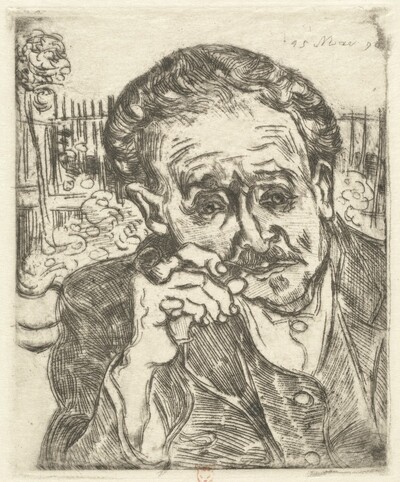
Auvers was Van Gogh's final chapter. Under the care of Dr. Gachet and working at a furious pace, he produced nearly eighty paintings in seventy days. The green wheat fields around Auvers became one of his obsessive subjects — he painted them again and again, in different weathers and at different times of day, as if the growing wheat were a symbol of the continuity he could not find in his own life.
Why It Matters
Green Wheat Fields is Van Gogh seeing the world with total intensity. The absence of a horizon means there is no escape from the visual field — the wheat is everywhere, overwhelming, alive. It is landscape as pure sensation, and it points directly toward the color-field painting of the 1950s.