Provenance
Acquired c. 1956 in Tulsa, Oklahoma, by William Roerick [1913-1995], Los Angeles; sold to (Zabriskie Gallery, New York); sold 1961 to Harold K. Hochschild [1892-1981], Princeton. (sale, Sotheby's, New York, 22 October 1981, no. 54). Dr. and Mrs. John E. Larkin, Jr., Dellwood, Minnesota; (sale, Sotheby's, New York, 2 June 1983, no. 77). Paul Mellon [1907-1999], Upperville, Virginia; bequest 1999 to NGA, with life interest to Mrs. Mellon; life interest released 2012.
Accession Number
2012.89.2
Medium
oil on canvas
Dimensions
overall: 25.8 × 55.1 cm (10 3/16 × 21 11/16 in.) | framed: 33.02 × 62.23 × 5.4 cm (13 × 24 1/2 × 2 1/8 in.)
Classification
Painting
Credit Line
Collection of Mr. and Mrs. Paul Mellon
Tags
Painting Impressionist & Modern (1851–1900) Oil Painting Canvas American
Background & Context
Background Story
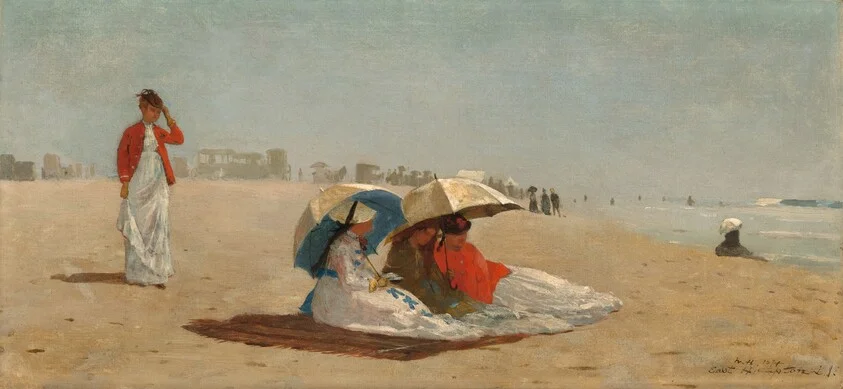
East Hampton Beach, Long Island (1874) depicts a coastal scene on Long Island's south fork, where Homer found subjects during the 1870s that complemented his Gloucester work. East Hampton, then a quiet farming and fishing community rather than the exclusive summer colony it would become, provided Homer with coastal subjects that had not yet been transformed by resort development. The painting likely depicts the broad, flat beach that characterizes East Hampton's shoreline—Atlantic waves meeting sandy beach with the directness that Homer loved in coastal subjects. The year 1874 places this during Homer's most productive period as a genre painter, when he was expanding his range of coastal subjects beyond Gloucester to include Long Island, New Hampshire, and other New England coastal communities. The painting captures a beach with its characteristic activities—bathing, fishing, socializing, or simply walking—that marked Long Island's coast before the Hamptons became synonymous with wealth and exclusivity. Homer's East Hampton is a working coast where fishermen and farmers interacted with the sea, not a leisure landscape for the wealthy. The painting's treatment of the flat, wide Long Island beach—distinct from Gloucester's rocky shore—demonstrates Homer's ability to adjust his art to different coastal types.
Cultural Impact
Homer's Long Island paintings influenced how the south shore was represented in American art before it became the Hamptons, documenting a working coastal landscape that resort development would largely replace. The paintings influenced American beach painting and contributed to the cultural memory of Long Island's pre-resort character. The paintings also documented the visual character of Long Island's coastline before extensive development.
Why It Matters
This painting matters because it captures a Long Island coast that no longer exists in the form Homer painted. East Hampton Beach in 1874 was a working community's shoreline; by the 20th century it had become one of America's most exclusive addresses. Homer's painting records the earlier reality—a document of what was lost when wealth transformed the Hamptons.